How to Reduce Your Forex Trading Costs: A Practical Checklist
Forex trading costs can often be reduced without changing your strategy, by matching account type to trade frequency, avoiding costly timing, sizing positions deliberately, and claiming cashback on every qualifying trade — four checks covered here.
By CB-Dogs Editorial4 min read
Disclosure: CB-Dogs receives an advertising (referral) fee — sometimes called an IB commission — from brokers for accounts opened or linked through us, and returns part of it to you as cashback, the same model used by cashback and points sites. This does not change your trading costs.
On this page
Most traders focus on strategy and leave trading costs as an afterthought — but costs are one of the few things you can control directly, regardless of how any particular trade turns out. This checklist walks through four places to look, in order of how much control you typically have over each one.
Key takeaways
- Trading costs come from four controllable areas: account type, timing, position sizing, and whether you claim cashback on your volume.
- Matching account type (spread-only vs. raw-spread-plus-commission) to your trade frequency can meaningfully change your total cost without changing your strategy.
- Avoiding predictably wide-spread moments — low liquidity, rollover, major news — reduces cost on trades where the timing itself isn't essential to the strategy.
- Sizing positions deliberately from a risk calculation, rather than habit, avoids both under-trading and unnecessarily large commission and swap exposure.
- Cashback rebates apply to volume you're already trading — claiming them doesn't require changing your strategy at all.
The checklist at a glance
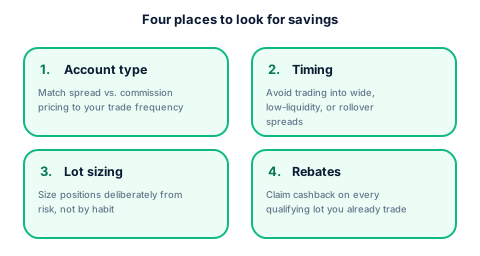
Four places consistently affect total trading cost regardless of your strategy: which account type you use, when you place trades, how you size positions, and whether you're capturing cashback on volume you're already generating. The rest of this guide covers each one.
1. Match your account type to your trading style
Most brokers offer at least two pricing structures: a standard account with a wider spread and no separate commission, and a raw-spread account with a much tighter spread plus a per-lot commission. Which is cheaper depends entirely on how often you trade — see our full raw spread vs. standard account comparison for the break-even formula, since the lot-size term cancels out and it comes down to trade frequency alone. A trader placing a handful of trades a month may do better on a standard account's simplicity; a high-frequency trader is often better served by the tighter raw spread, even after accounting for commission. Checking this once, using your own typical monthly volume, is a one-time fix that keeps paying off every month afterward.
2. Trade at times that don't work against you
Spreads aren't constant — they widen predictably around low-liquidity periods, at the daily rollover point when swap is applied, and around major scheduled news releases, as covered in our guides to trading sessions and spread widening and swap and overnight fees. If your strategy doesn't specifically require trading through one of these windows, avoiding them on trades where the timing is flexible reduces cost with no change to your actual analysis or entries. This isn't about avoiding volatility altogether — it's about recognizing when a wider spread is a cost you're paying for no strategic reason.
3. Size positions deliberately, not out of habit
Position size should come from a risk calculation — how much you're willing to risk on a trade, divided by your stop-loss distance in that instrument's terms — not from trading the same lot size regardless of setup. Our position-size-from-risk guide walks through the formula. Sizing deliberately avoids two opposite mistakes: trading too small relative to your account (leaving meaningful opportunities under-capitalized) and trading too large out of habit (multiplying spread, commission, and swap cost on a position bigger than your actual risk tolerance justifies). Since commission and swap scale directly with lot size, this step has a direct, calculable effect on total cost per trade — see our commission-per-lot guide for how that scaling works. The same principle applies to how many separate orders you split that size into and how many trades you place overall: see our guides to the cost of scaling in and out of a position and how overtrading increases your trading costs for two related ways deliberate sizing keeps cost down.
4. Claim cashback on every qualifying trade
Unlike the first three items, this one requires no change to how or when you trade at all. A cashback rebate is paid on qualifying closed lot volume regardless of account type, timing, or position size, so it stacks on top of whatever else you've already optimized. The main requirement is registering with a cashback provider before opening or linking your broker account, since attribution generally can't be applied retroactively — see our how forex rebates work guide for the full mechanics, and how to verify a provider is legitimate before choosing one.
Putting it together: a hypothetical before/after
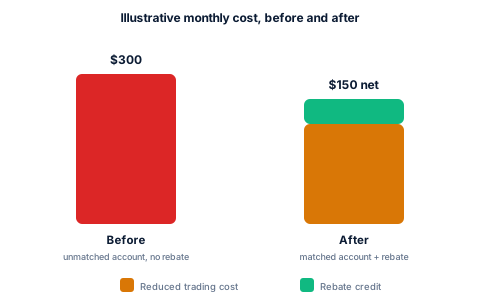
The figure above shows a fully hypothetical illustration: a trader paying around $300 a month in trading costs on an unmatched account type with no rebate, versus roughly $150 net after matching account type to trade frequency, avoiding a few predictably costly moments, sizing more deliberately, and claiming cashback on the same underlying volume. The actual numbers for any real trader depend entirely on their broker, account type, and trading pattern — this is meant to illustrate the shape of the improvement, not a number to expect.
Frequently asked questions
It depends on your trading style. High-frequency traders often see the biggest effect from account-type matching; traders holding positions overnight often benefit most from timing and swap awareness. Cashback applies regardless, since it's based on volume you're already generating.
Next steps
The cashback calculator shows what a rebate is worth for your own typical volume, and what a real monthly trading cost looks like walks through a fuller worked example combining several of these factors. Register with CB-Dogs before opening or linking your broker account so cashback applies from the start.
Risk warning: forex and CFD trading carries a high risk of losing money. Cashback does not offset trading losses. Nothing here is investment advice.
Related articles
Cashback on your XM trades — free, paid in USDT
Sign up free