How to Calculate Your Annual Forex Trading Costs from Monthly Volume
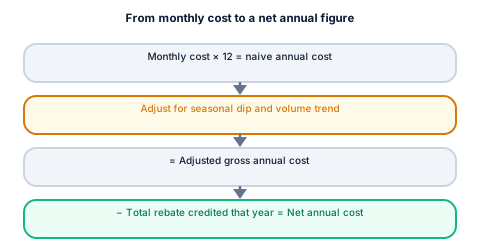
A first-pass annual forex trading cost estimate is your monthly cost multiplied by 12, but a more realistic figure adjusts that naive total for a typical seasonal volume dip and for any trend in your trading volume across the year, before subtracting the rebate that same volume would generate.
By CB-Dogs Editorial3 min read
Disclosure: CB-Dogs receives an advertising (referral) fee — sometimes called an IB commission — from brokers for accounts opened or linked through us, and returns part of it to you as cashback, the same model used by cashback and points sites. This does not change your trading costs.
On this page
Once you know your real monthly trading cost, the natural next question is what it adds up to over a full year — useful for personal budgeting, or for comparing two account types or brokers over a longer horizon than a single month can show. The naive answer is just multiplication; the more useful answer adjusts for two things most traders' volume doesn't actually hold constant across twelve months.
Key takeaways
- A first-pass annual cost estimate is simply your monthly trading cost × 12 — a reasonable starting point, not a finished answer.
- Two adjustments make the estimate more realistic: a seasonal dip in trading volume many traders experience during lighter periods, and any overall growth or decline trend in your trading volume across the year.
- The same three monthly-volume profiles used for a single month's cost calculation scale directly into an annual figure, keeping the comparison consistent.
- Subtracting the year's rebate from the adjusted gross figure gives a net annual cost — but the rebate total itself should come from the live rate, not a number typed into this article.
- This projection is most useful for comparing account types or brokers over a full year, or for personal budgeting — not as a guarantee of what any specific year will actually cost.
The naive annual formula
Annual cost ≈ Monthly cost × 12.
This is a legitimate starting point — see how to calculate your real monthly forex trading cost for the underlying monthly formula (spread + commission + swap, summed per trade and multiplied by monthly trade count). But flat multiplication assumes every month looks identical to the one you measured, which is rarely exactly true across a full year.
Two adjustments worth making
1. A seasonal volume dip. Many traders reduce activity during certain lighter periods across the year — a slower month, a holiday stretch, a stretch of low-liquidity conditions like the ones covered in forex trading sessions and when spreads widen. If your own pattern includes a lighter period, a flat ×12 overstates the year. An illustrative adjustment of roughly −8%, representing about one lighter month spread across the year, is used in the worked table below — your own actual pattern may differ meaningfully from this.
2. A trend in your trading volume. If you're deliberately scaling your position size or trade frequency up (or down) over the year, multiplying a single recent month by 12 will over- or understate the annual total in the direction of that trend. There's no universal formula for this one — it depends entirely on your own trajectory — but it's worth a mental adjustment (or a simple month-by-month sum instead of a single multiplication) if your volume this month doesn't resemble your volume six months ago.
Worked example: three volume profiles
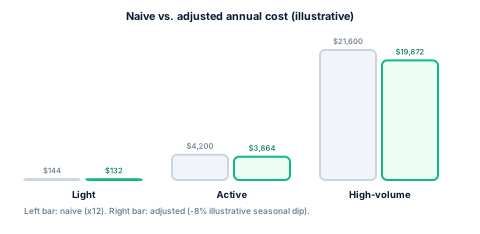
Using the same three illustrative profiles as the monthly-cost guide:
| Profile | Monthly cost | Naive annual (×12) | Adjusted annual (−8%, illustrative) |
|---|---|---|---|
| Light trader | $12 | $144 | ≈$132 |
| Active trader | $350 | $4,200 | ≈$3,864 |
| High-volume / EA trader | $1,800 | $21,600 | ≈$19,872 |
All figures are rounded, illustrative assumptions carried over from the monthly-cost worked example — not a prediction of any specific trader's actual annual cost.
Layering in the annual rebate
A rebate is calculated on qualifying closed lot volume and credited on an ongoing basis, not as a single year-end lump sum — the accumulation pattern itself, month by month, is covered separately in how forex cashback adds up over a year. This article's job is the cost side: once you have an adjusted gross annual cost figure from the table above, subtract whatever your real annual rebate total comes to, using the current live rate rather than a number typed into this article:
| Account type | Rebate / lot (USDT) |
|---|---|
| StandardSpread-based account, no commission. | 9.0 |
| MicroRebate is calculated per 100,000 units of micro-lot volume (i.e. the same per-lot rate as Standard, scaled to micro-lot size). | 9.0 |
| Ultra LowLower spreads, spread-based account, no commission. | 3.0 |
| KiwamiXM's tightened-spread account tier available in select regions. | 6.0 |
| ZeroCommission-based account. Rebate is paid in addition to the raw spread — commission you pay is unaffected. | 4.5 |
Provisional rate
Net annual cost = Adjusted gross annual cost − Total rebate credited that year.
Why this number is useful
A monthly figure is useful for a quick gut-check; an annual figure is the more useful one for two specific decisions: personal budgeting (knowing roughly what a full year of your trading pattern costs, gross and net), and comparing two account types or brokers when the comparison would otherwise be skewed by a single unusually light or heavy month. See how to compare broker total cost with rebates for extending this same annual lens to a side-by-side broker comparison.
Frequently asked questions
It's a reasonable starting point, but it assumes every month matches the one you measured. Adjusting for a seasonal volume dip or an ongoing trend in your own trading volume gives a more realistic figure.
Next steps
Start with your own monthly figure using how to calculate your real monthly forex trading cost, project it across a year with the adjustments above, then use the cashback calculator to estimate your annual rebate, or register with CB-Dogs so this year's volume starts counting.
Risk warning: forex and CFD trading carries a high risk of losing money. Cashback does not offset trading losses. Nothing here is investment advice.
Related articles
Cashback on your XM trades — free, paid in USDT
Sign up free