XM Minimum Deposit by Account Type (and by Funding Method)
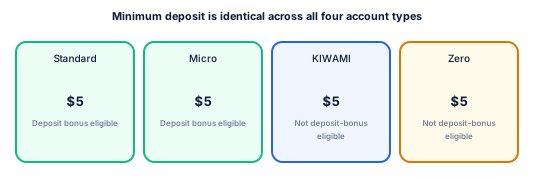
XMTrading's stated minimum deposit is $5 across all four of its account types (Standard, Micro, KIWAMI, and Zero), but the effective minimum for a specific deposit can be higher depending on the payment method and currency you use.
By CB-Dogs Editorial4 min read
Disclosure: CB-Dogs receives an advertising (referral) fee — sometimes called an IB commission — from brokers for accounts opened or linked through us, and returns part of it to you as cashback, the same model used by cashback and points sites. This does not change your trading costs.
On this page
Our XM account types comparison covers spreads, commission, and leverage side by side. This article isolates just one line from that comparison — the minimum deposit — and goes deeper into what it actually means in practice, since "$5" understates a few things that can trip up a first deposit.
Key takeaways
- XMTrading states the same $5 minimum deposit across all four account types: Standard, Micro, KIWAMI, and Zero.
- The $5 figure is XMTrading's own minimum; your specific payment method (card, e-wallet, or bank transfer) can set a higher practical floor.
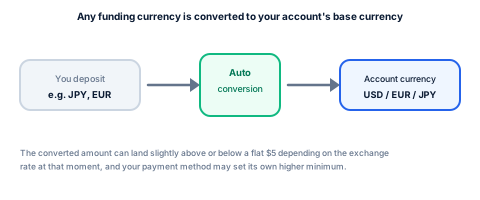
- Any currency you deposit is automatically converted to your account's base currency, so the displayed minimum can shift slightly depending on the exchange rate at the time.
- A $5 minimum lets you open an account and start trading, but it doesn't mean $5 is a sensible amount to trade meaningfully with once leverage, spread, and lot sizing are factored in.
- The minimum deposit is unrelated to CB-Dogs' own minimum withdrawal for cashback, which is 10 USDT, not $5.
The short answer
XMTrading's own account-types page lists a $5 minimum deposit for Standard, Micro, KIWAMI, and Zero accounts alike — there's no account type that requires a larger opening deposit than any other, at least as a stated minimum. XMTrading adds one qualifier directly on that same page: if you fund in a currency other than US dollars, the displayed minimum is converted to your funding currency, so the number you actually see at the payment screen won't always read exactly "$5" or its precise equivalent.
Minimum deposit by account type
| Account type | Minimum deposit (XMTrading's stated figure) | Deposit bonus eligible |
|---|---|---|
| Standard | $5 | Yes |
| Micro | $5 | Yes |
| KIWAMI | $5 | No |
| Zero | $5 | No |
There's no tiered minimum by account type the way there is for maximum leverage (covered in our XM leverage explained guide) — every account type shares the same $5 floor. The meaningful differences between account types are the ones covered in the full account types comparison: spread, commission, leverage cap, and bonus eligibility, not the minimum deposit.
Why the practical minimum can be higher than $5
XMTrading's $5 figure is its own floor — the amount below which it won't process a deposit at all, regardless of method. Three things can push your actual required amount above that:
- Your payment method's own minimum. A card processor, e-wallet, or bank may enforce a higher minimum transaction size than XMTrading itself does. The exact figure for your chosen method is shown at the point of deposit inside your member portal, not on XMTrading's public marketing pages.
- Currency conversion. XMTrading states that any deposit currency is automatically converted to your account's base currency (USD, EUR, or JPY). If you're funding in a currency other than your account's base currency, the exchange rate at that moment determines the converted amount, so "$5" can land as a slightly different number once converted.
- Rounding by your payment provider. Some payment rails only process round-number amounts or apply their own minimum transaction thresholds unrelated to XMTrading's rules.
Why $5 isn't necessarily a meaningful trading amount
Being allowed to open an account with $5 and being able to trade meaningfully with $5 are two different things. Even with XMTrading's maximum leverage tiers (see our leverage guide), a standard lot's notional value is large relative to a $5 balance, and a single pip of adverse movement on even a small position can represent a significant percentage of a $5 account. A $5 deposit is realistically useful mainly for testing that your deposit method and account work end to end — most traders fund considerably more than the stated minimum before placing anything beyond a very small test position. None of this is a recommendation of any specific deposit size; it depends entirely on your own risk tolerance and trading plan.
Minimum deposit vs. CB-Dogs' minimum withdrawal
It's easy to conflate XMTrading's $5 minimum deposit with CB-Dogs' own rules, but they're unrelated numbers from two different companies:
- XMTrading's $5 minimum is what you need to fund your trading account.
- CB-Dogs' 10 USDT minimum withdrawal is what you need accumulated in cashback before you can withdraw it, paid separately in USDT on the TRON (TRC20) network, with a 3 USDT fee below 50 USDT and no fee at 50 USDT or more. See our XM cashback calculator to estimate how long it takes your trading volume to clear that threshold.
Frequently asked questions
XMTrading states a $5 minimum deposit, and this figure is the same across all four of its account types: Standard, Micro, KIWAMI, and Zero.
Related reading
- XM account types compared — the full picture of what actually differs between Standard, Micro, KIWAMI, and Zero.
- XM leverage explained — how maximum leverage is tiered by account equity, unlike the flat minimum deposit.
- XM withdrawal: methods, times, and fees — the withdrawal side of your XMTrading account.
- How to open an XM account and link it to your cashback — the full sign-up sequence this deposit fits into.
- XM cashback calculator — estimate your cashback and check CB-Dogs' own minimum withdrawal, separate from XMTrading's deposit minimum.
- XM broker page — current cashback rates by account type.
Risk warning: forex and CFD trading carries a high risk of losing money. Cashback does not offset trading losses. Nothing here is investment advice.
Related articles
Cashback on your XM trades — free, paid in USDT
Sign up free