What Is a Forex Introducing Broker? IB Programs Explained
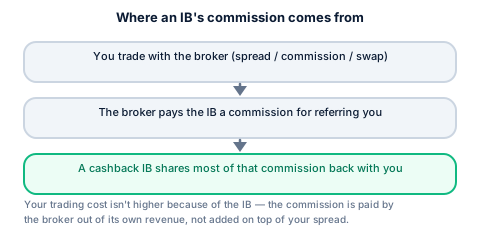
A forex introducing broker (IB) refers traders to a broker and is paid a commission from the broker's own revenue for that trading activity. A cashback-style IB shares most of that commission back with the trader instead of keeping it all.
By CB-Dogs Editorial4 min read
Disclosure: CB-Dogs receives an advertising (referral) fee — sometimes called an IB commission — from brokers for accounts opened or linked through us, and returns part of it to you as cashback, the same model used by cashback and points sites. This does not change your trading costs.
On this page
If you've registered with a cashback site before trading, you've probably seen the term "introducing broker," or IB, somewhere in the small print. It sounds like industry jargon, but the concept is simple once it's laid out, and understanding it explains exactly where cashback money comes from.
Key takeaways
- An introducing broker (IB) refers traders to a forex broker and is paid a commission by that broker, based on the trading activity of the accounts it refers.
- The commission comes from the broker's own revenue (spread, commission, or swap markup), not from an extra charge added to the trader's cost.
- A traditional IB keeps its full commission; a cashback-style IB discloses the fee and shares most of it back with the trader as a rebate.
- CB-Dogs operates as an IB for its partner brokers and pays cashback in USDT on qualifying trading volume, disclosed as an advertising (IB referral) fee arrangement.
- Being an IB doesn't change your trading conditions — your spread, commission, and execution come from the broker, independent of which IB referred you.
What an introducing broker actually is
A forex introducing broker is an individual or company that refers clients to a broker in exchange for a commission, without itself holding client funds, executing trades, or acting as the counterparty to any position. The broker handles all of that; the IB's role is limited to referring traders and, in most programs, providing some level of support or content around that referral relationship.
Brokers run IB programs because it's a cost-effective way to acquire trading clients: instead of spending on advertising with no guaranteed result, the broker pays a commission only when a referred account actually generates trading activity. That commission is typically calculated per lot traded, similar in structure to a sales commission tied to revenue rather than a flat referral fee.
How brokers pay an IB
The commission a broker pays an IB is calculated from the trading activity of the accounts referred through it — most commonly a fixed amount per standard lot traded, sometimes a percentage of the spread or commission the account generates instead. This is paid from the broker's own revenue on that account, not charged separately to the trader. In plain terms: your spread and commission are set by the broker and your account type, exactly the same whether you traded with no IB, a different IB, or CB-Dogs — the IB commission is a separate accounting line the broker pays out of what it already earns from your activity, not an add-on charge to you.
This is also why IB commission is usually described as being paid on volume, not on profit or loss. A losing trade generates the same commission as a winning trade of the same size, since the fee is tied to trading activity rather than account performance — see our guide to how forex brokers make money for how spread, commission, and swap fit into a broker's overall revenue. Some cashback programs also scale the rebate rate with volume, a structure covered in our guide to forex rebate volume tiers.
Where cashback fits: an IB that shares its commission
Most IBs — brokerages' own sales partners, content creators, referral programs bundled into other services — keep the commission they earn in full; it's simply revenue for running the referral relationship. A cashback site works differently: it operates as an IB for one or more brokers, then discloses that arrangement and shares most of the commission it earns back with the trader who generated it, paid out as a rebate.
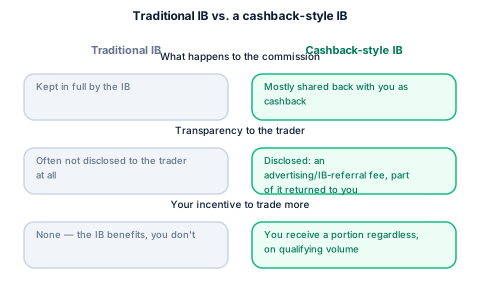
CB-Dogs is registered as an IB with its partner brokers and receives an advertising (IB referral) fee based on the trading activity of members who register through it. Most of that fee is returned to the member as cashback, paid in USDT — see how it works for the full disclosure and USDT forex rebates for how the payout itself works. This IB-funded cashback is a distinct mechanism from a broker's own loyalty or points-based rewards program, and the two can often be used alongside each other.
IB vs. affiliate marketing: what's the difference
The terms get used loosely, but there's a practical distinction. A pure affiliate typically earns a one-time payment (a "CPA," or cost-per-acquisition fee) when a referred trader deposits or opens an account, and the relationship often ends there. An IB earns an ongoing commission tied to the referred account's actual trading activity for as long as that account keeps trading — which is also why an IB-based cashback model can keep paying a rebate month after month, rather than only once at sign-up. Some programs blend both (an upfront CPA plus an ongoing IB commission); check which model a given site or program uses before assuming "affiliate" and "IB" always mean the same payout structure.
What to check before joining an IB program
Whether you're evaluating a cashback site or any other IB-based program, a few questions are worth answering before you register:
- Is the fee disclosed? A legitimate IB relationship should state plainly that it earns a commission from the broker, rather than presenting itself as an independent, disinterested reviewer.
- Does the IB actually pay out, and how? For a cashback IB specifically, check the payout method, minimum withdrawal, and any fees — see our guide to verifying a cashback provider is legitimate.
- Does it change your trading conditions? It shouldn't. Your spread, commission, execution, and account terms come from the broker and your chosen account type, not from which IB referred you.
- Is the IB itself neutral about brokers? An IB earning commission from a specific broker has an incentive to recommend that broker — reasonable disclosure of that incentive matters more than a claim of pure objectivity.
Frequently asked questions
No — the commission is paid by the broker from its own revenue on your trading activity, not added on top of your spread, commission, or swap.
Next steps
If you'd like to see how this works in practice, CB-Dogs' XM cashback page covers registration and account-type rates, and the cashback calculator estimates what a rebate is worth for your typical trading volume. Register with CB-Dogs before opening or linking your broker account so your trading activity can be tracked.
Risk warning: forex and CFD trading carries a high risk of losing money. Cashback does not offset trading losses. Nothing here is investment advice.
Related articles
Cashback on your XM trades — free, paid in USDT
Sign up free