Forex Broker Regulation Tiers Explained: What a Licence Means
Traders informally sort forex broker regulation into rough tiers, from major financial-center regulators with strict capital and segregation rules to lighter offshore registries. A licence lowers certain risks but never removes trading or market risk.
By CB-Dogs Editorial4 min read
Disclosure: CB-Dogs receives an advertising (referral) fee — sometimes called an IB commission — from brokers for accounts opened or linked through us, and returns part of it to you as cashback, the same model used by cashback and points sites. This does not change your trading costs.
On this page
"Is this broker regulated?" is one of the first questions most traders learn to ask — but regulation isn't a single yes-or-no property. Different regulators require different things, and traders informally group them into rough tiers when comparing brokers. This guide explains what those tiers mean, what a licence actually promises, and how to check one for yourself rather than taking a broker's word for it.
Key takeaways
- Regulation isn't binary — traders informally group regulators into rough tiers based on how strict their capital, conduct, and fund-segregation requirements are.
- A licence typically requires client-fund segregation and can include access to a compensation scheme, but it never eliminates market risk or guarantees against loss.
- You can verify a broker's licence yourself on the regulator's own public register, checking that the licence number and exact legal entity name both match.
- A broker can be genuinely regulated in one entity while trading with you through a different, unregulated or lighter-regulated entity of the same brand — always check which entity actually holds your account.
- This guide doesn't rank or recommend any specific broker or regulator — it explains how to evaluate regulation yourself.
Why "regulation" isn't one single thing
Every broker regulator sets its own rules for how much capital a firm must hold, whether client funds must be kept in segregated bank accounts, what reporting and audit obligations apply, and what recourse a client has if the firm fails. Because these requirements vary so much between regulators, traders don't just ask "is it regulated," they ask "regulated where, and how strictly" — which is where the informal tier system comes from.
The three rough tiers traders talk about
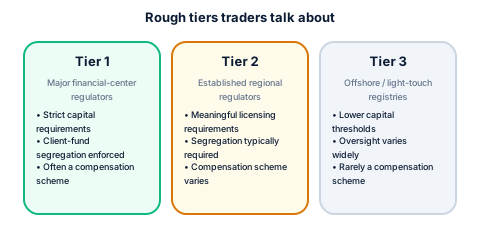
There's no official body that defines "Tier 1," "Tier 2," or "Tier 3" — it's informal shorthand that's become common in trader discussion and comparison sites. Broadly, and without naming specific regulators:
- Tier 1 describes regulators in major, well-established financial centers, typically requiring higher minimum capital, strict client-fund segregation, regular independent audits, and — in some cases — access to a formal compensation scheme if the firm fails.
- Tier 2 describes established regional regulators with meaningful licensing and conduct requirements, generally lighter than Tier 1 on capital thresholds or compensation-scheme access, but still involving a real application and ongoing supervision process.
- Tier 3 / offshore describes registries in jurisdictions with lower capital thresholds and lighter ongoing supervision. A licence still exists and still means something (the firm is a registered, identifiable legal entity, subject to at least some rules), but the practical protections and enforcement capacity are usually more limited.
None of this means a Tier 1-regulated entity is risk-free or that every offshore-regulated entity is a problem — it's a rough proxy for regulatory strictness, not a guarantee of quality, and plenty of well-run firms operate under lighter-touch regulation for legitimate structural reasons (serving markets a stricter regulator doesn't cover, for example).
What a licence actually promises (and doesn't)
A licence typically requires the firm to keep client funds in accounts separate from its own operating funds, follow certain conduct-of-business rules (such as fair marketing and complaint handling), and submit to some level of ongoing supervision or audit. Depending on the regulator, it may also mean access to a compensation scheme that can reimburse clients up to a set limit if the firm becomes insolvent.
How to check a regulator's register yourself
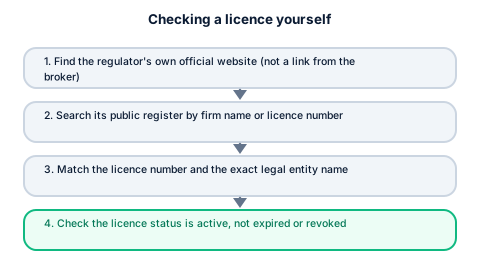
Most regulators maintain a free, public register you can search directly:
- Find the regulator's own official website — search for it independently rather than clicking a link the broker provides, since a fraudulent or clone site can link to a fake or lookalike register page.
- Search the public register by the firm's name or, more reliably, by the licence number stated on the broker's own site.
- Match both the licence number and the exact legal entity name. This step matters more than people expect — a group can have one entity genuinely licensed in a stricter jurisdiction and a differently-named entity (often "[Brand] International" or similar) licensed somewhere lighter, or not regulated at all, actually holding your account.
- Check the licence status is active, not expired, suspended, or revoked — registers usually show a current status, not just historical licensing.
Common tricks: clone firms and mismatched entities
Two patterns are worth specifically watching for. A clone firm copies the name, licence number, and sometimes the address of a genuinely regulated firm, then approaches traders separately (often via unsolicited contact) while having no actual connection to the real, regulated entity — regulators in several jurisdictions publish clone-firm warning lists precisely because of this. A mismatched entity is less deceptive but still important: the brand you recognize may hold a real licence through one entity, while the terms and conditions you actually accept, and the entity that actually holds your funds, is a different, less-regulated entity in the same corporate group. Reading which entity name appears in your account-opening documents — and checking that specific entity's licence, not just the brand's — closes both gaps.
Related reading
- Market maker vs. ECN vs. STP brokers — how broker model and regulatory tier relate to each other.
- What is a forex introducing broker? — how IB programs sit alongside a broker's own regulatory status.
Frequently asked questions
Not automatically — offshore regulation is a real licence with real requirements, just generally lighter than stricter jurisdictions. It's one input into your own risk assessment, not an automatic disqualifier.
Next steps
Once you've checked a broker's licence for yourself, our guide to verifying a cashback provider is legitimate covers the equivalent checks for the cashback side of the relationship, and our guide to how often forex rebates pay out covers what payout schedule to expect once you're earning cashback. Register with CB-Dogs to start tracking cashback on your qualifying trading volume once you're comfortable with a broker's regulatory standing.
Risk warning: forex and CFD trading carries a high risk of losing money. Cashback does not offset trading losses. Nothing here is investment advice.
Related articles
Cashback on your XM trades — free, paid in USDT
Sign up free