Market Maker vs. ECN vs. STP Brokers: What's the Difference?
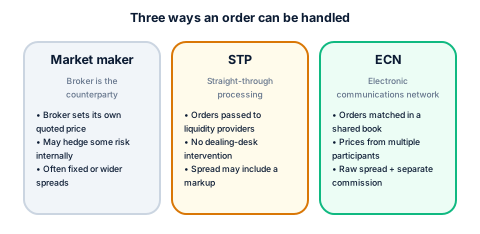
Market maker, STP, and ECN describe how a broker handles your order: as the counterparty on its own book, passed through to a liquidity provider, or matched in a shared order book. Each has a different typical pricing structure, and none is objectively best.
By CB-Dogs Editorial4 min read
Disclosure: CB-Dogs receives an advertising (referral) fee — sometimes called an IB commission — from brokers for accounts opened or linked through us, and returns part of it to you as cashback, the same model used by cashback and points sites. This does not change your trading costs.
On this page
- The three terms, in one sentence each
- Market maker: the broker is your counterparty
- STP: orders passed straight through
- ECN: orders matched in a shared order book
- How this relates to spread, commission, and rebates
- Why account type names don't always match the underlying model
- Frequently asked questions
- Next steps
"Market maker," "STP," and "ECN" show up constantly in broker marketing and comparison sites, often with an implication that one is inherently better than the others. In reality, they describe different ways an order can be handled — each with real trade-offs, and none universally superior. This guide explains each term plainly, without ranking any of them.
Key takeaways
- Market maker, STP, and ECN describe how a broker routes and prices your order — not whether the broker is trustworthy or regulated, which is a separate question entirely.
- A market maker broker is the counterparty to your trade and sets its own quoted price; STP passes orders through to external liquidity providers; ECN matches orders in a shared order book among multiple participants.
- Pricing structure typically differs by model: market maker pricing is often a single spread with no separate commission, while ECN typically pairs a tighter raw spread with a separate per-lot commission. STP can fall anywhere between.
- These terms describe execution, not regulation or safety — a broker's execution model doesn't tell you whether it's properly licensed, which is a separate check.
- Account type names (like 'ECN account') don't always guarantee the underlying execution model matches the name exactly — check the broker's own execution disclosure rather than assuming from the label alone.
The three terms, in one sentence each
A market maker broker is the counterparty to your trade and sets its own quoted price. STP (straight-through processing) passes your order directly to external liquidity providers without a dealing desk stepping in. ECN (electronic communications network) matches your order against other participants' orders in a shared, anonymous order book. All three are legitimate, widely used execution models — the right one for a given trader depends on strategy and priorities, not on one being universally "better."
Market maker: the broker is your counterparty
In a market-making model, the broker takes the other side of your trade directly rather than routing it to an external market. The broker sets its own bid and ask prices, and may choose to keep some or all of the resulting exposure itself, or hedge part of it elsewhere — a separate business decision often described using the A-book/B-book framework covered in our how forex brokers make money guide. Market maker pricing is commonly presented as a single spread with no separate commission, which can make costs simpler to estimate up front, particularly for smaller or less frequent trades.
STP: orders passed straight through
An STP broker routes your order to one or more external liquidity providers — typically banks or larger institutional participants — without a human dealing desk intervening in the pricing or execution decision. The broker isn't necessarily the counterparty to your trade in the same direct sense as a market maker, though it may still apply its own markup on top of the liquidity provider's raw price. STP sits functionally between market maker and ECN: orders leave the broker's own book, but without the fully shared, multi-participant order book that defines ECN.
ECN: orders matched in a shared order book
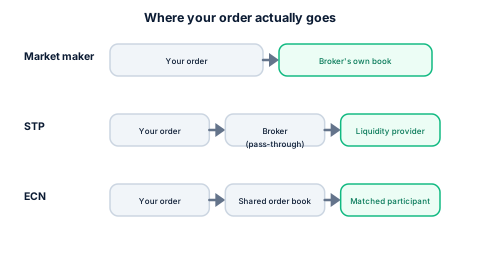
An ECN aggregates pricing from multiple participants — banks, other liquidity providers, and sometimes other traders — into a shared, live order book, and matches compatible buy and sell orders against each other. Because the broker isn't setting the price itself, ECN pricing is typically presented as a much tighter, variable "raw" spread, with the broker instead charging a separate, transparent per-lot commission for access to that order book — see our raw spread vs. standard account guide for how that pricing structure compares in total cost to a single-spread model.
How this relates to spread, commission, and rebates
None of these three models change how a cashback rebate is calculated — rebates are paid on qualifying closed lot volume regardless of whether that volume was filled on a market maker's own book, passed through via STP, or matched on an ECN. What does change is the shape of your trading cost: a market maker or STP account with a wider all-in spread and no separate commission looks different on a statement from an ECN account with a tight spread plus commission, even when the total cost ends up comparable. If you're reading a fee schedule to compare these, our guide to reading a broker's fee schedule covers where each cost component typically appears.
Why account type names don't always match the underlying model
Marketing labels aren't regulated the same way licensing claims are, so the safest approach is to treat "market maker," "STP," and "ECN" as descriptions of a typical pricing and routing pattern to expect, then verify the specifics — average spread, commission, and any execution disclosure, including a broker's own published execution statistics — against the broker's own published terms rather than the account type's name in isolation.
Frequently asked questions
Not necessarily — it depends on trade frequency and size. Our raw spread vs. standard account comparison works through the break-even math, since a tight spread plus commission isn't automatically cheaper than a single wider spread for every trading pattern.
Next steps
Our commission-per-lot guide and fee schedule guide go deeper into comparing the actual cost structures behind these models. Estimate your cashback for your typical volume, or register with CB-Dogs before opening or linking a broker account.
Risk warning: forex and CFD trading carries a high risk of losing money. Cashback does not offset trading losses. Nothing here is investment advice.
Related articles
Cashback on your XM trades — free, paid in USDT
Sign up free