Forex Correlation and Hedged Pairs: How Correlation Affects Your True Trading Cost
Trading two correlated currency pairs to offset directional risk doesn't reduce transaction costs — each leg still carries its own spread, commission and swap, so a two-leg "hedge" typically costs at least twice as much as a single position, regardless of how strong the correlation is.
By CB-Dogs Editorial4 min read
Disclosure: CB-Dogs receives an advertising (referral) fee — sometimes called an IB commission — from brokers for accounts opened or linked through us, and returns part of it to you as cashback, the same model used by cashback and points sites. This does not change your trading costs.
On this page
Two currency pairs that move together — or in opposite directions — are described as correlated. Traders sometimes use that relationship to offset risk, opening positions in two correlated pairs instead of one. What correlation doesn't do is make the trade cheaper: every leg of a multi-pair position pays its own spread, its own commission (if the account is commission-based), and its own swap. This guide walks through why the cost side of correlation trades is easy to underestimate.
Key takeaways
- Correlation describes how closely two pairs' price movements track each other, from +1.0 (move together) to -1.0 (move in opposite directions).
- Opening a second, correlated position to offset directional risk is a cost event, not a cost saving — each leg pays its own spread, commission, and swap independently.
- A two-leg position built from correlated pairs typically costs at least twice the transaction cost of a single-pair position of the same size.
- Correlation is a historical statistical relationship, not a fixed rule — it drifts, weakens, or reverses, so a hedge built on it carries basis risk on top of its transaction cost.
- Rebates are generally credited per qualifying lot traded, so a two-leg hedge earns rebate on both legs — it just doesn't erase the fact that both legs also cost money to open and close.
What currency pair correlation means
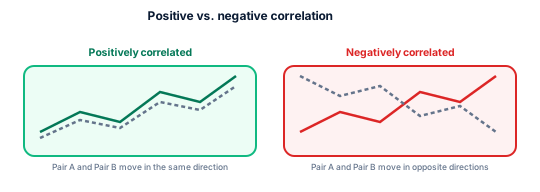
A correlation coefficient measures how closely two pairs' price movements have tracked each other over a given period, on a scale from -1.0 to +1.0. A reading near +1.0 means the pairs have moved in the same direction most of the time; a reading near -1.0 means they've moved in opposite directions; a reading near 0 means little consistent relationship. EUR/USD and GBP/USD are commonly cited as positively correlated (both are "USD on the quote side" pairs that tend to react similarly to broad dollar strength or weakness), while EUR/USD and USD/CHF are commonly cited as negatively correlated. These relationships are calculated from historical price data over a chosen lookback window and shift over time — they are a statistical tendency, not a fixed law.
Why traders combine correlated pairs
A trader who wants to reduce directional exposure to the US dollar, for example, might open an offsetting position in a second, correlated pair rather than simply closing the first one — perhaps to preserve a specific trade thesis on each pair individually, or as part of a broader portfolio approach. From a market-exposure standpoint, this can genuinely reduce net directional risk when the correlation holds. From a cost-accounting standpoint, it does something different: it adds a second position, in full, on top of the first.
The cost side: two legs, two full cost events
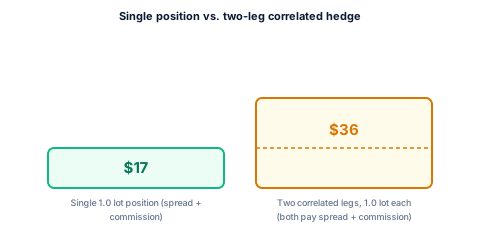
Opening a position in Pair A and a second position in Pair B, even when the two are highly correlated, means paying the spread on Pair A, the spread on Pair B, any per-lot commission on both, and swap on both overnight positions. None of these costs are shared or reduced because the pairs move together. Using illustrative, hypothetical figures: if a 1.0 lot position in Pair A costs $10 in spread and $7 in commission (round turn), and a 1.0 lot position in Pair B costs $12 in spread and $7 in commission, the two-leg combination costs $36 — roughly double what either leg costs alone, not a discount for being "hedged." This is true whether the correlation between the two pairs is +0.95 or +0.60; the transaction-cost side of the ledger doesn't know or care how correlated the pairs are.
Correlation drifts — the hedge itself carries basis risk
A second, separate risk sits on top of the cost: correlation is not guaranteed to hold going forward just because it held historically. Two pairs that moved together for months can decouple around a specific news event, a central bank divergence, or a shift in one currency's underlying drivers. When that happens, a position built to offset risk can instead add to it — the trader is now paying the full transaction cost of two positions and carrying directional exposure the hedge was meant to reduce. This gap between expected and actual correlation is often called basis risk, and it's a reason correlation-based positioning is generally treated as a portfolio-level risk tool, not a way to trade for free.
How this interacts with rebate eligibility
Cashback is typically calculated on qualifying closed lot volume, independent of why a trade was opened. A two-leg correlated position generally earns rebate on both legs, the same as any other two trades of the same size would. That doesn't offset the point above — the rebate is a partial return on a cost that was still paid twice, not a reason to treat the second leg as free. Broker-specific rules can still exclude certain patterns (for example, extremely short-duration or clearly wash-style trade pairs) from qualifying volume; see forex hedging and rebate eligibility for how those eligibility rules work, which is a separate question from the cost-accounting point covered in this article.
Frequently asked questions
No — both approaches involve opening a second position, and both pay that second position's own spread, commission, and swap. A correlated-pair hedge additionally carries basis risk if the correlation weakens, which a same-pair hedge doesn't.
Next steps
See how spread, commission and swap combine into a single position's cost in forex lot, pip and spread cost explained, check how hedged positions are treated for rebate purposes in forex hedging and rebate eligibility, or register with CB-Dogs to earn cashback on your qualifying volume either way.
Risk warning: forex and CFD trading carries a high risk of losing money. Cashback does not offset trading losses. Nothing here is investment advice.
Related articles
Cashback on your XM trades — free, paid in USDT
Sign up free