Gold Stop Loss: How Many Pips or Dollars? Sizing a Stop on XAUUSD
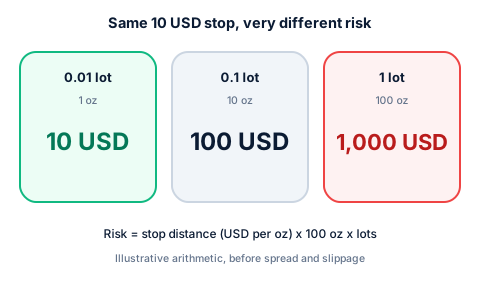
On gold, think in dollars per ounce, not pips: a 1 USD move is worth 100 USD per standard lot (100 oz), so a 10 USD stop risks 10 USD at 0.01 lot and 1,000 USD at 1 lot. Pick the stop from market structure or volatility (ATR), then size the lot from your fixed risk percentage.
By CB-Dogs Editorial7 min read
Disclosure: CB-Dogs receives an advertising (referral) fee — sometimes called an IB commission — from brokers for accounts opened or linked through us, and returns part of it to you as cashback, the same model used by cashback and points sites. This does not change your trading costs.
On this page
- What a pip or point means on XAUUSD
- From a stop distance in dollars to account risk
- Sizing the stop to a fixed percentage of your account
- Choosing the distance: structure and ATR
- Spread, slippage and news: why the real stop is wider
- How cost relates to stop distance
- What cashback changes, and what it does not
"How many pips should my gold stop loss be?" has no single answer, because a pip on gold is not a fixed thing. Brokers and platforms label gold's smallest increments differently, so the safest way to think is in dollars of price move per ounce. From there everything else is arithmetic: dollars of risk for your lot size, the lot size that fits a fixed percentage of your account, and how much of your stop the spread eats before the trade has a chance to work.
This guide walks through that arithmetic with clearly labelled example figures. It does not tell you where your stop should go. That depends on your strategy, and nothing here is a recommendation.
Key takeaways
- Gold is quoted to two decimals. A 1.00 USD move per ounce is worth 100 USD on a standard lot (100 oz), 10 USD on 0.1 lot and 1 USD on 0.01 lot.
- Pip and point labels vary by broker and platform (a 0.01 move is a 'point' on some, a 0.10 move is a 'pip' on others). Convert any stop to dollars per ounce first, then to account risk.
- Fixed-percentage sizing: lot size = money you accept to lose divided by (stop distance in USD x 100). Round the lot size down, never up.
- Volatility-based stops (for example a multiple of ATR) adapt to current conditions. Spreads and slippage widen around news, so a tight stop near a data release is easier to hit for the wrong reason.
- Cashback offsets part of the spread but never a stop-out. At XMTrading, trades lasting 5 minutes or less earn no IB commission and therefore no cashback.
What a pip or point means on XAUUSD
Gold (XAUUSD, the price of one troy ounce in US dollars) is normally quoted with two decimals, for example 2,400.00. The smallest price step is therefore 0.01 USD per ounce. A standard lot of gold is 100 ounces (see how much is one lot of gold), which gives the two numbers that matter:
- A 1.00 USD move in the price is worth 100 USD per standard lot (1.00 x 100 oz).
- A 0.01 USD move, the smallest quoted step, is worth 1 USD per standard lot.
What you call these steps depends on who you ask. Some platforms treat the 0.01 step as one point (so a standard lot is worth 1 USD per point). Others call a 0.10 move a pip (so a standard lot is worth 10 USD per pip). Our pip value reference shows both conventions side by side.
XMTrading adds one more wrinkle. Its instruments pages quote gold's minimum spread and swap in XM's own "points", and the size of that unit is not necessarily the same as the "pips" in a generic tutorial. Do not assume a number such as "4" on that page equals 4 pips or 0.40 USD. Open the symbol specification in your platform (in MetaTrader, right-click the symbol in Market Watch and choose Specification) and compare the digits and point size with the live price.
The simple fix is to ignore the labels. Write your stop as a price distance: "my entry is 2,400.00 and my stop is 2,390.00, so the stop is 10.00 USD per ounce away." That sentence means the same thing on every broker.
From a stop distance in dollars to account risk
Risk in account currency is:
Risk (USD) = stop distance (USD per oz) x 100 oz x lots
The table shows the risk for a few stop distances at three common sizes. All figures are illustrative arithmetic on a USD account, before spread, slippage and commission.
| Stop distance (USD per oz) | 0.01 lot (1 oz) | 0.1 lot (10 oz) | 1 lot (100 oz) |
|---|---|---|---|
| 2.00 | 2 USD | 20 USD | 200 USD |
| 5.00 | 5 USD | 50 USD | 500 USD |
| 10.00 | 10 USD | 100 USD | 1,000 USD |
| 20.00 | 20 USD | 200 USD | 2,000 USD |
The point of the table is how fast gold risk scales. A stop that feels ordinary on gold, say 10 USD, is a 1,000 USD loss on one lot. Many newer traders size gold like a forex pair and are surprised, which is why understanding the lot size comes first.
Sizing the stop to a fixed percentage of your account
A common discipline is to decide how much of the account you accept to lose on one trade (many traders pick a small percentage, but the choice is yours), place the stop where the trade idea is wrong, and only then derive the lot size:
Lots = (account x risk %) / (stop distance in USD x 100)
Worked example with illustrative numbers: a 5,000 USD account risking 1% means 50 USD at risk.
| Stop distance | Calculation | Raw lot size | Rounded down to a tradable size |
|---|---|---|---|
| 5.00 USD | 50 / (5 x 100) | 0.100 | 0.10 (risk 50 USD) |
| 10.00 USD | 50 / (10 x 100) | 0.050 | 0.05 (risk 50 USD) |
| 20.00 USD | 50 / (20 x 100) | 0.025 | 0.02 (risk 40 USD) |
Notice the direction of the relationship: a wider stop means a smaller position, not a larger risk. If your stop must be wide, your size must shrink. If the resulting lot size falls below the minimum (0.01 lot), the trade is too big for the account at that risk percentage, and the honest answer is to skip it or to knowingly accept more risk. The general method for any instrument is in how to calculate position size from risk.
Choosing the distance: structure and ATR
The distance itself comes from the market, not the formula. Two common starting points:
- Structure. Place the stop beyond a level that would invalidate your idea, such as a recent swing high or low or a broken support. If that level is 18 USD away, the stop is 18 USD away, and the lot size follows from the formula above.
- Volatility (ATR). The Average True Range indicator measures the typical range per candle over a chosen period. Traders often set the stop at a multiple of the current ATR so it scales with conditions. The multiple and the timeframe are choices you test, not facts.
Gold's daily range changes a lot over time. In calm weeks it can be modest, and around inflation data, central bank meetings or geopolitical shocks it can be several times larger. Rather than quoting a statistic that goes stale, read the ATR of the timeframe you trade on your own chart today, and treat last month's number as history. If you ever copy an "average daily range" figure from a website, check the date and the source.
A stop placed only a few dollars from entry on a volatile day is often hit by ordinary noise rather than by your idea being wrong. That is the practical argument for sizing the position to the stop instead of squeezing the stop to fit a position.
Spread, slippage and news: why the real stop is wider
Your stop is a price, but the market you trade has a bid and an ask. A buy position closes at the bid, so a stop sitting 10 USD below your entry is triggered when the bid reaches it, and the ask at entry was already above the bid by the spread. In effect, the spread is paid up front and the trade starts slightly in the red.
Two things make this worse at the wrong moment:
- Spread widening. Around major releases, rollover and thin liquidity, gold's spread can widen well beyond its usual level. XMTrading's listed minimum spreads are exactly that, minimums. See XM gold spread and trading conditions.
- Slippage and gaps. A stop order becomes a market order when triggered, so in a fast move it can fill beyond your price. Guaranteed stops, where offered, work differently and usually cost more. Compare them in stop, trailing and guaranteed stop-loss types.
Gold is especially sensitive to US data. If you trade NFP, CPI or FOMC days, read trading gold on news first, and consider that a 3 USD stop in the minute of a release is mostly a bet on spread and slippage.
How cost relates to stop distance
The spread is a cost you pay on entry, and it is easy to compare with the stop. Example figures only: suppose gold's spread is 0.30 USD per ounce at the moment you enter.
- On 0.1 lot (10 oz), that spread costs 0.30 x 10 = 3 USD.
- Against a 10 USD stop (100 USD risk), the spread is 3% of the stop distance.
- Against a 2 USD stop (20 USD risk), the same spread is 15% of the stop distance.
The tighter your stop, the larger the share of it that is cost before price has moved at all. This is why very tight gold stops and frequent scalping make spread the dominant factor in results. A wider spread (news, off-hours) raises the ratio for any stop distance.
What cashback changes, and what it does not
Cashback returns a share of the broker's IB commission to you. At CB-Dogs it is 60% of the IB commission XMTrading actually pays, per lot traded, regardless of whether the trade wins or loses. The current rates are shown here and update automatically:
| Account type | Rebate / lot (USDT) |
|---|---|
| StandardSpread-based account, no commission. | 1.8 |
| MicroShown per micro lot (1,000 units), which is 1/100 of a standard lot, so the amount is 1/100 of the Standard amount. | 0.018(1 micro lot = 1,000 units) |
| KiwamiXM's tightened-spread account tier available in select regions. Our rebate for this account type is still being confirmed with XM and will be added here. | Rate to be confirmed |
| ZeroCommission-based account. Rebate is paid in addition to the raw spread, and the commission you pay is unaffected. Our rebate for this account type is still being confirmed with XM and will be added here. | Rate to be confirmed |
Provisional rate
Illustrative arithmetic using the Standard figure of 1.8 USDT per standard lot at the current partner level (this can change): a 0.1 lot gold trade earns about 0.18 USDT. Compared with the example 3 USD spread above, that offsets roughly 6% of the entry cost. It is a small, real reduction in cost, not a reason to take a trade and certainly not an offset for a stop-out. For a deeper look at the per-lot numbers, see gold (XAUUSD) cashback per lot explained.
One rule matters directly for stop-placement style. Under XMTrading's publicly available partner terms, trades lasting 5 minutes or less (open to close) do not count for IB commission, so they earn no cashback. If your tight gold stops get hit within minutes, those trades pay the full spread with no rebate. The full list of exclusions is in which XM trades are excluded from cashback. Never choose a stop distance or trade length to chase cashback; the spread and the stop-out will cost far more than the rebate returns.
FAQ
There is no fixed number. Define the stop as a price distance in dollars per ounce, based on market structure or volatility such as ATR, then size the lot from your risk percentage. Pip and point labels differ by broker, so convert to dollars first.
Risk warning: forex and CFD trading carries a high risk of losing money. Cashback does not offset trading losses. Nothing here is investment advice.
Related articles
Cashback on your XM trades — free, paid in USDT
Sign up free