Forex Cashback in Kenya: CMA Rules, Session Times in EAT and USDT Rebates
A Kenya guide for forex traders: what the CMA says about unlicensed brokers, how to check a licence yourself, sessions in EAT, receiving USDT safely, and KRA pointers.
By CB-Dogs Editorial8 min read
Disclosure: CB-Dogs receives an advertising (referral) fee — sometimes called an IB commission — from brokers for accounts opened or linked through us, and returns part of it to you as cashback, the same model used by cashback and points sites. This does not change your trading costs.
On this page
Kenya is one of the few African markets with a dedicated licensing regime for online forex brokers, and Kenyan traders tend to ask the right first question: is this broker licensed by the CMA? This guide explains what the Capital Markets Authority actually says, how to check a broker's status yourself in a few minutes, when the major sessions fall in East Africa Time, how to receive and convert USDT without getting scammed, and where tax questions belong. It also explains, plainly, what CB-Dogs is and what it can't promise you.
Last reviewed: 26 September 2026. Rules and registers change — we recheck this page every quarter.
The short answer
- Kenya regulates online forex brokers through the Capital Markets Authority (CMA) under the Capital Markets (Online Foreign Exchange Trading) Regulations, 2017. The CMA has told brokers it has not licensed to stop onboarding Kenyan investors.
- The CMA publishes a licensee register and a public caution list. Checking both takes a few minutes and is the single most useful thing you can do before opening any account.
- Some international broker groups run a separate Kenyan-licensed company and offshore companies under the same brand. Which company your account is actually opened with is decided at the broker's signup, not by the brand name — check it yourself.
- CB-Dogs pays cashback in USDT on the TRC20 network. Converting USDT to shillings is up to you; use a regulated service or P2P escrow, never an off-platform deal.
- Rebates may be taxable. The authority is the Kenya Revenue Authority (KRA); ask a Kenyan tax professional about your situation.
What the CMA says about online forex brokers
The 2017 Regulations create three licensed categories: dealing online forex broker, non-dealing online forex broker, and money manager. Carrying on (or holding out as carrying on) that business in Kenya without the relevant CMA licence is an offence for the firm.
The CMA's cautionary statement on online forex trading by unlicensed entities asks all online forex brokers and money managers not licensed by the Authority to stop trading, running "sensitisations" in Kenya, and onboarding Kenyan investors. The CMA also issues periodic public cautions naming specific unlicensed platforms and investment schemes.
What this means for you as a trader, in practical terms:
- A broker being famous, having a Kenyan-looking website, or accepting M-Pesa deposits does not tell you it is CMA-licensed.
- If your account is held by a company that is not on the CMA register, you should assume you would not have the protection of Kenyan rules if something goes wrong.
- The Regulations do not create a licence category for affiliates or cashback sites. That is why CB-Dogs does not describe itself as "CMA-approved" or an "authorised introducing broker" — it isn't, and nobody should tell you otherwise.
How to check a broker's licence yourself
This takes about five minutes and works for any broker, not just ours.
- Find the legal entity. On the broker's website footer, the account-opening terms, or your client portal, find the exact company name that will hold your account (not just the brand).
- Search the CMA licensee register. Go to the CMA's licensee portal (plain-text reference: licensees.cma.or.ke) and open the online foreign exchange broker categories. Compare the company name and licence number exactly.
- Check the public caution list. The CMA posts public cautions against named unlicensed entities and investment scams (reference: cma.or.ke, "Public Caution" notices). Search the brand name and the company name.
- Watch for look-alikes. Scam sites copy real brand names with small spelling changes or different domains. Type the broker's address yourself rather than following links from messages.
- Recheck occasionally. Licences can be suspended or revoked, and new caution lists are issued throughout the year.
Red flags that apply whatever the register says: guaranteed or fixed monthly returns, "account managers" who want to trade for you, pressure to recruit friends, requests to send money to a personal M-Pesa number or someone else's wallet, and "withdrawal fees" you must pay before you can take money out.
Forex session times in Kenya (EAT, UTC+3)
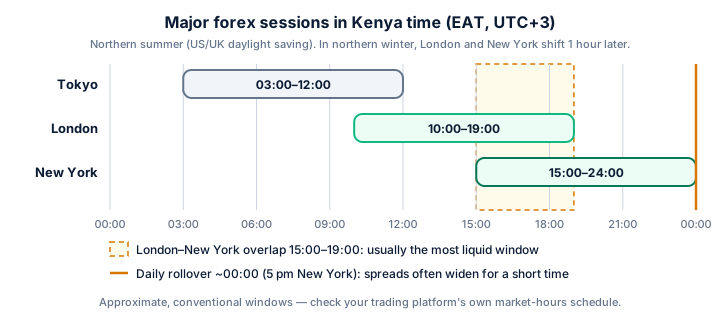
Kenya uses East Africa Time all year, with no daylight saving. The US and UK do change their clocks, so the London and New York windows shift by one hour between northern summer and winter.
| Session | Northern summer (approx., EAT) | Northern winter (approx., EAT) |
|---|---|---|
| Tokyo | 03:00–12:00 | 03:00–12:00 |
| London | 10:00–19:00 | 11:00–20:00 |
| New York | 15:00–24:00 | 16:00–01:00 |
| London–New York overlap | 15:00–19:00 | 16:00–20:00 |
| Daily rollover (5 pm New York) | ~00:00 | ~01:00 |
UK clocks change on the last Sundays of March and October; US clocks on the second Sunday of March and the first Sunday of November, so for a few weeks each year only one of them has shifted.
For many Kenyan traders the London–New York overlap falls in the afternoon and early evening, which is usually the most liquid part of the day for major pairs. Around the midnight rollover spreads commonly widen for a short time. Session windows are conventions, not official opening hours — check your platform's own schedule. More detail: forex trading sessions and when spreads widen.
Receiving your cashback in USDT (TRC20) in Kenya
CB-Dogs pays cashback only in USDT on the TRON (TRC20) network, to a wallet address you control. You need a wallet that supports TRC20 USDT; the receiving address starts with a capital T. Our wallet setup guide walks through it.
Kenya's Virtual Asset Service Providers Act took effect in November 2025, and its implementing regulations were gazetted in 2026. They license businesses such as exchanges and custodians; they are new, and how they apply in practice is still settling. If you convert USDT to shillings, the safest general approaches are:
- A regulated exchange that is licensed (or formally in the licensing process) for Kenya and pays out to a bank account or mobile-money account in your own name. Check the licensing status on the regulator's official site yourself rather than trusting an exchange's own claims.
- P2P trading inside a platform's escrow, where the platform locks the USDT until you confirm the shillings have actually arrived.
Scam patterns we see Kenyan traders warned about most often:
- Fake M-Pesa confirmation messages or screenshots. Only your own M-Pesa balance or bank statement proves payment.
- Reversal tricks — a buyer pays, you release the USDT, then they request a reversal or claim a "wrong number" transfer.
- "Let's finish this on WhatsApp for a better rate" — leaving the platform removes the escrow and your ability to dispute.
- Fake support agents contacting you first. Real support never asks for your seed phrase.
Full walkthrough: how to convert USDT to local currency safely and USDT scams and address poisoning.
Taxes: point yourself to KRA
Cashback, trading gains and crypto transactions may all have tax consequences in Kenya. Kenya also introduced a tax on digital-asset transactions in 2023, and the rules around digital assets have been changing since. We are not able to tell you how any of this applies to you.
- The authority is the Kenya Revenue Authority (reference: kra.go.ke).
- Treat rebates as potentially taxable income until a qualified Kenyan tax professional tells you otherwise.
- Keep records: payout dates, amounts, and transaction IDs (TXIDs). See keeping records of forex rebates for taxes.
This is general information, not tax advice.
How CB-Dogs works
- You register with CB-Dogs and open a trading account with a partner broker through our link (the broker decides whether to accept you and which of its companies holds your account).
- When you trade, the broker pays CB-Dogs an advertising (IB referral) fee based on your closed volume. Your spreads and trading conditions are the same as without us.
- We return part of that fee to you as cashback. Current per-lot rates come from our live data:
| Account type | Rebate / lot (USDT) |
|---|---|
| StandardSpread-based account, no commission. | 9.0 |
| MicroRebate is calculated per 100,000 units of micro-lot volume (i.e. the same per-lot rate as Standard, scaled to micro-lot size). | 9.0 |
| Ultra LowLower spreads, spread-based account, no commission. | 3.0 |
| KiwamiXM's tightened-spread account tier available in select regions. | 6.0 |
| ZeroCommission-based account. Rebate is paid in addition to the raw spread — commission you pay is unaffected. | 4.5 |
Provisional rate
- Cashback is credited after the broker has paid us, and becomes withdrawable after the broker's confirmation period (XM: 7 days after crediting). From trade to withdrawable typically takes around 3–4 weeks for XM — a guide, not a guarantee.
- Withdraw once you have at least 10 USDT. Withdrawals of 50 USDT or more are fee-free; below that, a flat 3 USDT fee applies. After you change your wallet address, withdrawals pause for 24 hours for security.
To estimate what your own volume would return, use the calculator:
1 standard lot = 100,000 units of the base currency.
Used only to show how the fee-free threshold applies below.
Rate used
9.0 USDT per lot
Estimated monthly cashback
90.0 USDT
Estimated yearly cashback
1080.0 USDT
If you withdrew 100 USDT today
No fee — you're at or above the 50 USDT fee-free threshold.
You would receive 100.0 USDT
Figures are estimates based on provisional rates and the trading volume you enter. They are not a guarantee of future cashback and do not account for excluded trades.
Honest limitations
- CB-Dogs is not a broker and does not hold, move or manage your trading funds. Deposits and withdrawals on your trading account are between you and the broker.
- We are not CMA-licensed, and we don't claim any broker account opened through our link is held by a Kenyan-licensed company. Verify that yourself as described above.
- Broker availability can change. Whether a broker accepts Kenyan residents, and on what terms, is decided on the broker's own signup.
- Cashback lowers costs; it doesn't create profits. Most retail CFD traders lose money, and a rebate does not change that.
- We can only pay what the broker pays us, so timing depends on broker reporting.
Frequently asked questions
Kenya regulates online forex brokers through the Capital Markets Authority. The CMA licenses brokers and money managers and has told unlicensed brokers to stop onboarding Kenyan investors. Before trading, check that the company holding your account appears on the CMA licensee register. This is general information, not legal advice.
Related guides
Risk warning: forex and CFD trading carries a high risk of losing money. Cashback does not offset trading losses. Nothing here is investment advice.
Related articles
Cashback on your XM trades — free, paid in USDT
Sign up free