Forex Cashback in South Africa: FSCA Checks, Session Times in SAST and USDT Rebates
Forex/CFD brokers serving South Africans must be authorised by the FSCA as Financial Services Providers — traders should confirm the exact company holding their account on the FSCA's own register rather than trusting the broker's brand name.
By CB-Dogs Editorial7 min read
Disclosure: CB-Dogs receives an advertising (referral) fee — sometimes called an IB commission — from brokers for accounts opened or linked through us, and returns part of it to you as cashback, the same model used by cashback and points sites. This does not change your trading costs.
On this page
South Africa has the most developed forex and crypto regulation in sub-Saharan Africa, and South African traders are used to checking whether a firm is "FSCA regulated". That is the right instinct — as long as you check the right company. This guide explains how FSCA authorisation works, how to verify a broker yourself, when the major sessions fall in South African Standard Time, how to receive and convert USDT safely, and where to take tax questions. It also sets out what CB-Dogs is, and its limits.
Last reviewed: 26 September 2026. We recheck this page every quarter.
Key takeaways
- South African forex/CFD brokers must be FSCA-authorised Financial Services Providers under the FAIS Act.
- The company that actually holds your account is decided at broker signup — verify that exact entity on the FSCA register, not the marketing brand.
- South Africa uses SAST (UTC+2) year-round, so the London and New York session windows shift by an hour when those regions change their clocks.
- CB-Dogs pays cashback only in USDT on the TRON (TRC20) network; converting it to rand should go through an FSCA-licensed crypto asset service provider or platform escrow.
- SARS treats crypto assets as taxable, so cashback and trading proceeds may need to be declared and records kept.
The short answer
- Forex/CFD brokers that provide financial services to South Africans are authorised by the Financial Sector Conduct Authority (FSCA) as Financial Services Providers (FSPs) under the FAIS Act.
- The FSCA runs a public search for authorised firms and publishes warnings about unauthorised ones. Use both.
- Many international brokers have a South African-authorised company and companies elsewhere under the same brand. Which company holds your account is decided at the broker's signup — check it yourself.
- CB-Dogs pays cashback in USDT on TRC20. Crypto asset service providers are licensed by the FSCA; converting to rand through a licensed provider or P2P escrow is up to you.
- Rebates may be taxable. The authority is SARS; ask a South African tax practitioner.
How FSCA authorisation works
Under the Financial Advisory and Intermediary Services (FAIS) Act, firms that give advice or act as intermediaries on financial products for South African clients need to be authorised by the FSCA as FSPs, and each has an FSP number. Forex and CFD brokers serving South Africans typically hold this authorisation through a local company. The FSCA also regularly warns the public about entities that claim to offer such services without authorisation.
What this means for you in practice:
- "FSCA regulated" on a website is a claim, not proof. The proof is the FSCA's own search result for the exact company that holds your account.
- If your account is held by a company that isn't FSCA-authorised, South African complaint routes and conduct rules may not be available to you if something goes wrong.
- FAIS definitions are broad. CB-Dogs does not advise you on what or when to trade, doesn't recommend products for your circumstances, and doesn't describe itself as an authorised FSP — because it isn't one.
How to check a broker's FSCA status yourself
- Get the exact company name and FSP number from the broker's website footer, account terms or client portal.
- Search the FSCA's regulated-entities database. On the FSCA website (plain-text reference: fsca.co.za → Regulated Entities → search), search by name or FSP number. Check that the status is authorised, and that the licence categories cover the products you will trade (derivatives such as CFDs).
- Check the FSCA's warnings. The FSCA publishes press releases and warnings about unauthorised firms and clone sites (reference: fsca.co.za → News / warnings). Search the brand and the company name.
- Beware clones. Fraudsters copy the names and FSP numbers of real firms. Contact details on the FSCA record should match the site you're using.
- Recheck from time to time. Authorisations can be suspended, withdrawn or changed.
Red flags whatever the register says: guaranteed returns, "account managers" who trade for you, pressure to recruit others, and demands for a fee before a withdrawal can be released.
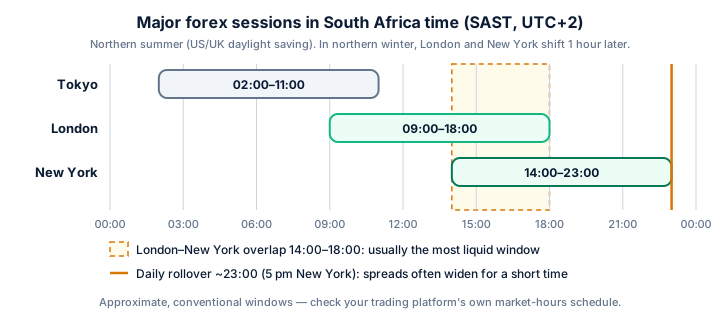
Forex session times in South Africa (SAST, UTC+2)
South Africa uses SAST all year with no daylight saving. The US and UK do change their clocks, so London and New York shift by one hour between northern summer and winter.
| Session | Northern summer (approx., SAST) | Northern winter (approx., SAST) |
|---|---|---|
| Tokyo | 02:00–11:00 | 02:00–11:00 |
| London | 09:00–18:00 | 10:00–19:00 |
| New York | 14:00–23:00 | 15:00–24:00 |
| London–New York overlap | 14:00–18:00 | 15:00–19:00 |
| Daily rollover (5 pm New York) | ~23:00 | ~00:00 |
UK clocks change on the last Sundays of March and October; US clocks on the second Sunday of March and the first Sunday of November.
Note that "summer" here means the northern summer: during South Africa's own summer (roughly November to March), London and New York are mostly on winter time, so the right-hand column applies. The overlap falls in the South African afternoon — usually the most liquid window for major pairs — and spreads commonly widen for a short time around the late-evening rollover. Check your platform's own schedule; these windows are conventions. More detail: forex trading sessions and when spreads widen.
Receiving your cashback in USDT (TRC20) in South Africa
CB-Dogs pays cashback only in USDT on the TRON (TRC20) network, to a wallet you control. The receiving address starts with a capital T; see our wallet setup guide.
The FSCA declared crypto assets a financial product under FAIS in 2022 and licenses crypto asset service providers (CASPs) such as exchanges. That regime licenses businesses; you don't need a licence to receive USDT into your own wallet. If you convert USDT to rand:
- Use a CASP that appears on the FSCA's register and pays out to a bank account in your own name. Search the provider's legal name on the FSCA site rather than relying on its marketing.
- Or use P2P trading inside a platform's escrow, releasing USDT only after the rand has cleared in your account.
Moving money across borders through banks is subject to South African Reserve Bank exchange-control allowances; ask your bank or a professional if a transaction may involve offshore transfers.
Common scams to watch for:
- Fake proof of payment — PDFs or screenshots of an EFT that hasn't actually arrived. Check your own banking app.
- Clone exchanges and fake "FSCA-licensed" crypto platforms promising high yields.
- Off-platform offers for a better rate, and fake support agents who contact you first or ask for your seed phrase.
Full walkthrough: how to convert USDT to local currency safely and USDT scams and address poisoning.
Taxes: point yourself to SARS
The South African Revenue Service (SARS) treats crypto assets as within the tax net, and whether amounts are taxed as income or capital can depend on your circumstances. Cashback and trading results may have tax consequences too. We can't tell you how this applies to you.
- The authority is SARS (reference: sars.gov.za).
- Treat rebates as potentially taxable until a registered South African tax practitioner advises otherwise.
- Keep records of payout dates, amounts, ZAR values at the time, and transaction IDs (TXIDs). See keeping records of forex rebates for taxes.
This is general information, not tax advice.
How CB-Dogs works
- You register with CB-Dogs and open a trading account with a partner broker through our link. The broker decides whether to accept you and which of its companies holds your account.
- When you trade, the broker pays CB-Dogs an advertising (IB referral) fee based on your closed volume. Your spreads and trading conditions stay the same.
- We return part of that fee to you as cashback. Current per-lot rates come from our live data:
| Account type | Rebate / lot (USDT) |
|---|---|
| StandardSpread-based account, no commission. | 9.0 |
| MicroRebate is calculated per 100,000 units of micro-lot volume (i.e. the same per-lot rate as Standard, scaled to micro-lot size). | 9.0 |
| Ultra LowLower spreads, spread-based account, no commission. | 3.0 |
| KiwamiXM's tightened-spread account tier available in select regions. | 6.0 |
| ZeroCommission-based account. Rebate is paid in addition to the raw spread — commission you pay is unaffected. | 4.5 |
Provisional rate
- Cashback is credited after the broker has paid us, and becomes withdrawable after the broker's confirmation period (XM: 7 days after crediting). From trade to withdrawable typically takes around 3–4 weeks for XM — a guide, not a guarantee.
- Withdraw once you have at least 10 USDT. Withdrawals of 50 USDT or more are fee-free; below that, a flat 3 USDT fee applies. Withdrawals pause for 24 hours after a wallet-address change.
Estimate what your own volume would return:
1 standard lot = 100,000 units of the base currency.
Used only to show how the fee-free threshold applies below.
Rate used
9.0 USDT per lot
Estimated monthly cashback
90.0 USDT
Estimated yearly cashback
1080.0 USDT
If you withdrew 100 USDT today
No fee — you're at or above the 50 USDT fee-free threshold.
You would receive 100.0 USDT
Figures are estimates based on provisional rates and the trading volume you enter. They are not a guarantee of future cashback and do not account for excluded trades.
Honest limitations
- CB-Dogs is not a broker and does not hold or manage your trading funds.
- We are not an FSCA-authorised FSP, we give no financial advice, and we don't claim any account opened through our link is held by an FSCA-authorised company. Verify that yourself.
- Broker availability can change. Whether a broker accepts South African residents, and which of its companies serves you, is decided on the broker's own signup.
- Cashback does not make trading profitable. Most retail CFD traders lose money.
- We can only pay what the broker pays us, so timing depends on broker reporting.
Frequently asked questions
Yes, forex and CFD trading is a regulated activity in South Africa. Firms providing these financial services to South Africans are authorised by the FSCA under the FAIS Act. Check the exact company that holds your account on the FSCA's regulated-entities search. This is general information, not legal advice.
Related guides
Risk warning: forex and CFD trading carries a high risk of losing money. Cashback does not offset trading losses. Nothing here is investment advice.
Related articles
Cashback on your XM trades — free, paid in USDT
Sign up free