What Is a Pip in Crypto CFDs vs. Forex? Contract and Pip-Size Basics
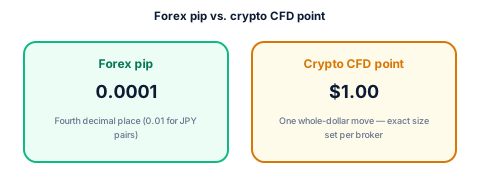
Forex pairs quote price moves in pips, typically the fourth decimal place (second for JPY pairs); most crypto CFDs instead quote in whole-dollar "points" or ticks because of the asset's price magnitude, so the two aren't comparable without converting through each instrument's own contract size.
By CB-Dogs Editorial3 min read
Disclosure: CB-Dogs receives an advertising (referral) fee — sometimes called an IB commission — from brokers for accounts opened or linked through us, and returns part of it to you as cashback, the same model used by cashback and points sites. This does not change your trading costs.
On this page
Forex traders learn pip value early: a fixed unit of price movement, usually the fourth decimal place, with a fairly standard dollar value once lot size is fixed. Crypto CFDs — contracts for difference on Bitcoin, Ethereum and similar assets, offered by some CFD brokers — don't use the same convention, which trips up traders moving between the two. This is a neutral, mechanics-only comparison of how price movement is measured and priced in each.
Key takeaways
- A **pip** in most forex pairs is the fourth decimal place of the quoted price (0.0001), or the second decimal place for JPY pairs (0.01).
- Most crypto CFDs quote price movement in whole-dollar "points" or ticks rather than pips, because the asset's price magnitude (thousands or tens of thousands of dollars) makes a pip-style fourth-decimal unit impractical.
- Contract size differs sharply: a standard forex lot is 100,000 units of the base currency, while a crypto CFD "lot" or contract size is commonly defined as a fraction or multiple of one coin, set per broker.
- Because both the price-move unit and the contract size differ, a cost-per-pip forex formula doesn't carry over to crypto CFDs without first checking the specific instrument's tick size and contract size.
- Crypto CFD availability, leverage limits, and terminology vary by broker and by jurisdiction — always check your own broker's contract specification before trading, and confirm crypto CFDs are permitted for your account and location.
What a pip means in forex
A pip is the standard unit of price movement in most forex pairs — 0.0001 for pairs quoted to four decimal places, and 0.01 for pairs where one side is the Japanese yen, which is quoted to two decimal places. On a standard 100,000-unit lot, one pip is worth approximately $10 when the quote currency is USD (see pip value for major pairs and gold for the full table and formula). This consistency — a fixed decimal unit, a fixed contract size, a fairly predictable dollar value — is specific to how forex pairs are conventionally quoted and sized.
Why crypto CFDs use a different convention
A major forex pair typically trades somewhere between 0.5 and 2, so a fourth-decimal pip captures a meaningful, tradeable increment of that price. A crypto asset like Bitcoin can trade in the tens of thousands of dollars, where a fourth-decimal movement is meaningless — instead, most CFD brokers quote crypto price movement in whole-dollar points or ticks (a $1.00 move is commonly one point), and calculate profit and loss directly from that dollar move multiplied by the contract size. The underlying idea — a standard unit of price movement, multiplied by contract size, gives a dollar value — is the same as forex; only the unit itself and its scale are different.
Contract size: the other moving part
Forex's 100,000-unit standard lot is a long-standing industry convention. Crypto CFD contract sizes have no equivalent universal standard — a broker might define one "lot" as 1 coin, 0.1 coin, or another fraction, and this varies by broker and sometimes by the specific crypto asset. That means the dollar value of "one point of movement" on a crypto CFD depends entirely on that broker's contract specification, in the same way pip value in forex depends on lot size and the quote currency's exchange rate.
A worked, illustrative comparison
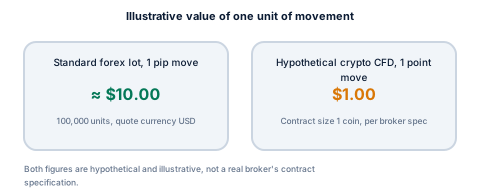
Using hypothetical, illustrative numbers only: a standard EUR/USD lot moving one pip (0.0001) changes the position's value by roughly $10. A hypothetical crypto CFD with a contract size of 1 coin moving one point ($1.00) changes the position's value by exactly $1.00 per contract, regardless of the coin's price level — because the contract size is denominated in coins, not in a currency-pair notional value. Multiplying either figure by position size and number of points/pips moved gives the total price-driven gain or loss on that trade — the two formulas parallel each other even though the units don't match. Neither figure is a real broker's published contract specification.
What doesn't carry over between the two
Spread, commission, swap/overnight financing, and margin requirements for crypto CFDs commonly follow different conventions than spot forex too — often quoted as a percentage of notional value rather than a fixed pip amount, and margin requirements for crypto CFDs are frequently higher given the asset's volatility. None of that is standard across brokers, so treat any specific number as broker-declared rather than assumed from forex conventions. Crypto CFD trading — where offered at all — is also subject to its own regulatory treatment, leverage caps, and eligibility rules that differ by broker and by jurisdiction; this article describes general contract mechanics only and isn't a statement that crypto CFDs are available, permitted, or advisable in any particular location.
Frequently asked questions
They serve the same conceptual role — a standard unit of price movement — but they're not numerically interchangeable. A pip is typically a fourth-decimal move; a crypto CFD point is commonly a whole-dollar move. Always check the specific instrument's contract specification.
Next steps
For the forex side of pip mechanics, see forex lot, pip and spread cost explained and pip value for major pairs and gold, or register with CB-Dogs to start earning cashback on your qualifying trading volume.
Risk warning: forex and CFD trading carries a high risk of losing money. Cashback does not offset trading losses. Nothing here is investment advice.
Related articles
Cashback on your XM trades — free, paid in USDT
Sign up free