Exness vs. XM: An Honest Comparison for Cashback Traders
Exness and XM aren't a simple 'which pays more cashback' question: XM's per-lot cashback figures tend to be larger because XM's spreads are wider, while Exness's are typically smaller because Exness's spreads and commissions are tighter — what actually matters is net cost (spread plus commission, minus cashback), not the cashback number alone.
By CB-Dogs Editorial6 min read
Disclosure: CB-Dogs receives an advertising (referral) fee — sometimes called an IB commission — from brokers for accounts opened or linked through us, and returns part of it to you as cashback, the same model used by cashback and points sites. This does not change your trading costs.
On this page
"Exness or XM" isn't really one question — it's several: which account type fits how you trade, and, since you're reading this on a cashback site, how the cashback difference between them actually plays out. That last part is where comparisons go wrong most, so this guide covers account types and cost model first, then works through the cashback question honestly, with a hypothetical net-cost example rather than a headline "X pays more" claim.
Key takeaways
- XM (our IB relationship is with XMTrading) offers Standard, Micro, KIWAMI, and Zero. Exness offers Standard, Pro, Zero, and Raw Spread. Only Zero (XM) and Zero/Raw Spread (Exness) charge a separate commission; the rest fold cost into the spread.
- XM cashback is a fixed dollar amount per lot, set per account type. Exness cashback is a percentage share of the actual spread/commission revenue it pays us, so the displayed figures are estimates that move with the real numbers.
- XM's per-lot cashback figures tend to be larger than Exness's, not because XM is more generous, but because XM's spreads are wider to begin with. Exness's tighter spreads mean smaller cashback, but a lower gross cost too.
- The number that tells you which is cheaper for you is net cost per lot — gross trading cost minus cashback — not the cashback figure alone. See the worked hypothetical example below.
- Both brokers serve international clients under an offshore regulatory entity rather than a top-tier one; check each broker's own regulatory page before assuming a specific protection level applies.
XM and Exness at a glance
Both are multi-asset brokers offering forex, metals, indices, and more on MT4/MT5, and both accept clients CB-Dogs can pay cashback to outside Japan, the US, Canada, the UK, and the EU/EEA (see our eligibility page for the full list). Beyond that overlap, the two run differently:
- XM, referred to on our site by its XMTrading brand, is regulated by entities licensed with the Seychelles Financial Services Authority (FSA) and the Mauritius Financial Services Commission (FSC) for the international clients we work with — a long-established brand with a wide account lineup and a deposit bonus on some account types.
- Exness onboards international clients (outside the EU/UK) primarily under an entity regulated by the Seychelles FSA — the exact entity is confirmed per client when the account is opened. Exness is known for tighter raw spreads and a high-volume, lower-cost positioning.
Neither carries top-tier protections like the UK's FCA or an EU MiFID II compensation scheme for the accounts CB-Dogs clients actually open — that's the trade-off of an offshore-licensed international account generally, not something specific to one broker. Check each broker's own regulation page for the exact entity your account lands under.
Account types and cost model
XMTrading's four account types: Standard and Micro are spread-based with no separate commission (Micro just scales position size down). KIWAMI is XM's tightened-spread tier, still spread-only. Zero pairs a near-zero headline spread with a disclosed per-lot commission — see our XM Zero account review for the mechanics.
Exness's four account types: Standard is spread-based with no separate commission, and its spread is wider than the commission-based tiers since the broker's cost is folded entirely into it. Pro is also spread-based, tighter than Standard. Zero and Raw Spread are both commission-based, pairing a much tighter raw spread with a separate, disclosed per-lot commission.
The shape is similar on both — a spread-only tier or two plus a commission-based tier — but the actual numbers differ, which is what drives the cashback comparison below. Our guide to raw spread vs. standard accounts covers the break-even math for choosing a commission-based tier on either broker.
Deposits and withdrawals
Both brokers support standard deposit and withdrawal methods that vary by region and change over time, so we won't put numbers here that could go stale — check each broker's funding page. What we can say with certainty is how CB-Dogs' side works regardless of broker: cashback is paid only in USDT on TRC20, 10 USDT minimum withdrawal, free from 50 USDT, 3 USDT fee below that. XM's cashback typically becomes withdrawable roughly 3-4 weeks after a trade (a 7-day hold after we import the commission report); Exness's is an estimated 2-3 weeks on the same 7-day hold — an estimate, since we have less payout history with Exness so far.
The cashback difference: why the numbers aren't directly comparable
This is the part worth slowing down on. CB-Dogs' cashback isn't calculated the same way on both brokers:
- XM pays a fixed dollar amount per lot, set per account type. It doesn't move with the specific spread on any individual trade.
- Exness pays us a percentage share of the actual spread or commission revenue it earns on your trading, so our displayed Exness figures are estimates at our current partner rank — they rise as our volume with Exness grows, and your actual cashback is always calculated from the real commission Exness reports, not the estimate.
Our guide to per-lot vs. percentage cashback covers this mechanic further. In practice: because Exness's spreads and commissions are structurally tighter than XM's, its percentage share translates into smaller per-lot dollar figures than XM's fixed rate — not because Exness is less generous, but because there's less underlying revenue to share.
| Account type | Rebate / lot (USDT) |
|---|---|
| StandardSpread-based account, no commission. | 9.0 |
| MicroRebate is calculated per 100,000 units of micro-lot volume (i.e. the same per-lot rate as Standard, scaled to micro-lot size). | 9.0 |
| KiwamiXM's tightened-spread account tier available in select regions. | 6.0 |
| ZeroCommission-based account. Rebate is paid in addition to the raw spread — commission you pay is unaffected. | 4.5 |
Provisional rate
| Account type | Rebate / lot (USDT) |
|---|---|
| StandardNo separate commission — Exness pays partners a share of the spread. The estimate below is for EURUSD at our current partner rank; GBPUSD and gold (XAUUSD) typically pay more per lot, tighter-spread pairs less. Rates rise automatically as our trading volume with Exness grows. | 0.96 |
| ProNo separate commission — Exness pays partners a share of the spread, at a lower percentage than Standard. We don't yet have a reliable per-instrument estimate for this account type, so no figure is shown; your cashback is still 60% of the actual commission Exness pays us. | 0.0 |
| ZeroCommission-based account with near-zero raw spreads. The estimate below is for EURUSD at our current partner rank; other instruments vary. Cashback is paid in addition to the raw spread and does not affect the commission you pay Exness. | 0.25 |
| Raw SpreadCommission-based account with raw interbank spreads. Exness pays partners a fixed amount per lot that varies by instrument; we don't yet have a reliable figure to show, so no estimate is listed — your cashback is still 60% of the actual commission Exness pays us. | 0.0 |
Provisional rate
Seeing XM's numbers above sit higher than Exness's per lot is the expected pattern, not a sign one program pays out more fairly than the other. A wider-spread account generating a bigger fixed rebate and a tighter-spread account generating a smaller percentage-based one are two different ways of returning part of a cost you were already going to pay — the size of the rebate on its own doesn't tell you which one leaves you better off.
What actually matters: net cost per lot (a hypothetical example)
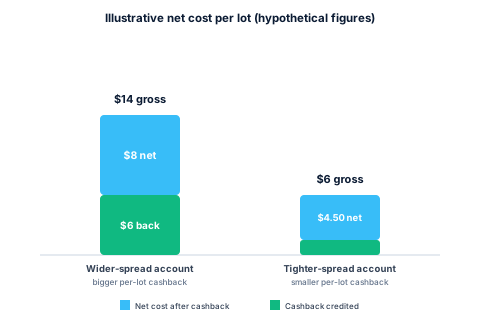
The number that answers "which is cheaper for me" is net cost per lot = gross trading cost (spread plus commission) − cashback per lot, covered in full in our guide to comparing broker cost with rebates included. Using clearly hypothetical, rounded numbers — not a live quote from either broker:
| Wider-spread account (illustrative) | Tighter-spread account (illustrative) | |
|---|---|---|
| Gross cost per lot | $14.00 | $6.00 |
| Cashback credited | $6.00 | $1.50 |
| Net cost per lot | $8.00 | $4.50 |
In this made-up example, the tighter-spread account ends up cheaper net of cashback, despite its cashback figure looking much smaller — because its starting cost was lower to begin with. Change the actual numbers and the ranking can flip; plug in the real, current figures from the rate tables above and each broker's own published spread for the pair and account type you trade. The cashback calculator is the reliable way to run this yourself, rather than assuming either broker wins by default.
Who each suits
Neither broker is a universal answer, and this isn't a "winner" call:
- XM (XMTrading) tends to suit traders who value a wide, established account lineup, a deposit bonus on some account types, and a fixed, predictable cashback figure they can calculate in advance.
- Exness tends to suit traders who prioritize the tightest available raw spreads and lower-cost trading, and who are comfortable with a cashback rate that's an estimate tied to revenue share rather than a flat number — useful if minimizing gross cost matters more to you than the cashback figure itself.
Some traders reasonably use both, trading the pairs and styles that suit each broker's cost structure separately, and linking both to CB-Dogs so qualifying volume on either earns cashback.
Frequently asked questions
XM's displayed per-lot figures are typically larger because XM's spreads are wider; Exness's are typically smaller because its spreads and commissions are tighter. A bigger cashback number doesn't automatically mean a lower net cost — see the worked example above.
Related reading
- Per-lot vs. percentage cashback — why XM and Exness figures aren't directly comparable.
- Comparing two brokers' total cost with rebates — the net-cost formula used above.
- Raw spread vs. standard account — the break-even math for a commission-based tier.
- XM account types compared — the full four-way XMTrading breakdown.
- XM Zero account review — a deep dive on XM's commission-based tier.
- XM broker page and Exness broker page — live rates and hold-period details for every account type.
Ready to compare with your own numbers? Register with CB-Dogs, link whichever broker (or both) you trade with, and run the cashback calculator against your real volume.
Risk warning: forex and CFD trading carries a high risk of losing money. Cashback does not offset trading losses. Nothing here is investment advice.
Related articles
Cashback on your XM trades — free, paid in USDT
Sign up free