Forex Order Types and Their Cost Implications (Market, Limit, Stop)
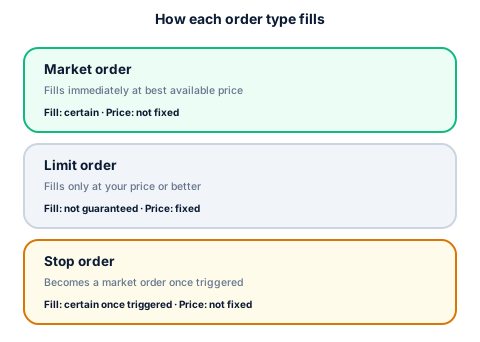
A market order fills immediately but exposes you to slippage; a limit order guarantees your price but may not fill; a stop order becomes a market order once triggered, inheriting the same slippage risk, often more since stops cluster around common levels.
By CB-Dogs Editorial4 min read
Disclosure: CB-Dogs receives an advertising (referral) fee — sometimes called an IB commission — from brokers for accounts opened or linked through us, and returns part of it to you as cashback, the same model used by cashback and points sites. This does not change your trading costs.
On this page
Spread, commission, and swap get most of the attention in cost discussions, but the type of order you use to enter or exit a trade also has a real, if less obvious, cost dimension: how likely you are to get the price you expected, versus a worse one. This guide compares market, limit, and stop orders on that basis.
Key takeaways
- A market order fills immediately at the best available price but can suffer slippage in fast or thin markets
- A limit order only fills at your specified price or better, so it has no negative slippage by definition but may never fill
- A stop order sits inactive until triggered, then executes as a market order and inherits the same slippage risk
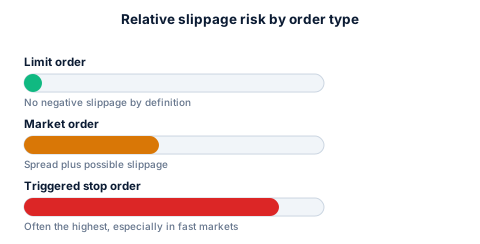
- Triggered stop orders often see more slippage than manual market orders since they cluster around common technical levels
- Cashback is calculated from qualifying closed lot volume, not from which order type was used to enter or exit a trade
Market orders: certain fill, uncertain price
A market order executes immediately at the best currently available price. The cost implication: you always pay the spread at that instant, and in fast-moving or thin markets, you can also experience slippage — the difference between the price you expected when you clicked and the price you actually got, which can move for or against you. See our slippage and requotes guide for how that's typically defined and measured. A market order's real cost is the spread plus any slippage; you always get filled, but you don't control the exact price.
Limit orders: price certainty, fill uncertainty
A limit order only fills at your specified price or better — a buy limit fills at or below the price you set; a sell limit fills at or above it. The cost implication is essentially the reverse of a market order: you know the worst price you'll pay if the order fills, but the order might not fill at all if the market never reaches your level. There's no negative slippage on a standard limit order by definition (it either fills at your price or better, or doesn't fill), but the opportunity cost of a missed fill is a real cost in its own right, even though it's not a fee.
Stop orders: a market order with a trigger
A stop order sits inactive until the market reaches a specified trigger price, at which point it becomes a market order. A buy stop triggers above the current price; a sell stop (including a stop-loss on a long position) triggers below it. Because a triggered stop order executes as a market order, it inherits the same slippage exposure as any market order — and often more, since stops frequently cluster around the same technical levels and can trigger during exactly the fast-moving conditions where slippage is worst. This is the same underlying mechanic covered from the risk-management side in our stop-loss types guide, which also covers the guaranteed-stop variant some brokers offer for a disclosed fee specifically to remove this slippage risk.
Stop-limit orders: a hybrid, with its own trade-off
A stop-limit order combines the two: once triggered, it becomes a limit order rather than a market order. This removes the slippage risk a plain stop order carries, but reintroduces the fill-uncertainty problem — in a fast-moving market, the price can blow through your limit level before the order can fill, leaving the position open when a plain stop would have closed it (at a worse price, but closed). Neither behavior is objectively better; it's a genuine trade-off between price control and fill certainty.
A worked example (illustrative)
Suppose EUR/USD is trading at 1.1000 and a trader places a buy stop at 1.1020 to enter on a breakout. If the market gaps quickly through that level during a fast release, the order might fill at 1.1024 instead of 1.1020 — 4 pips of slippage, in addition to the spread paid at execution. Had the same trader used a stop-limit at 1.1020 with a 1.1022 limit cap, the order might not fill at all if the price moved straight past 1.1022 without trading at or below it, leaving the breakout entry missed entirely. Neither outcome is "wrong" — they're the two different failure modes each order type carries. These figures are a round, illustrative example, not a live quote or a specific broker's fill data.
Where cashback fits in
Cashback is calculated from qualifying closed lot volume, not from which order type was used to enter or exit a trade — a market order, a limit order, and a stop order that all close the same lot size generate the same qualifying volume. See how forex rebates work for the underlying mechanics. Order-type choice affects your entry/exit cost, not your rebate eligibility.
Frequently asked questions
None is universally cheapest — a limit order has no slippage risk but might not fill; a market order always fills but carries spread plus possible slippage; a stop order inherits market-order slippage risk once triggered. The right choice depends on whether fill certainty or price certainty matters more for that specific trade.
Whichever order type you use
Cashback applies the same way regardless of order type, as long as the resulting volume qualifies. Use the cashback calculator to estimate rebates on your typical monthly volume, or register with CB-Dogs.
Risk warning: forex and CFD trading carries a high risk of losing money. Cashback does not offset trading losses. Nothing here is investment advice.
Related articles
Cashback on your XM trades — free, paid in USDT
Sign up free