Gold (XAUUSD) Margin Per Lot Explained: Formula and a Worked Example
Required margin for a gold (XAUUSD) position equals contract size (commonly 100 troy ounces per standard lot) multiplied by price, divided by leverage — at a hypothetical $2,000/oz price and 1:500 leverage, that works out to roughly $400 for 1.0 lot, $40 for 0.1 lot, or $4 for 0.01 lot.
By CB-Dogs Editorial6 min read
Disclosure: CB-Dogs receives an advertising (referral) fee — sometimes called an IB commission — from brokers for accounts opened or linked through us, and returns part of it to you as cashback, the same model used by cashback and points sites. This does not change your trading costs.
On this page
- The gold margin formula
- Worked example: 1.0 lot of gold at a hypothetical price
- Required margin by leverage and lot size (hypothetical $2,000/oz)
- Why leverage on gold isn't always your account's headline number
- Margin isn't the same question as risk
- Does margin affect your cashback?
- Frequently asked questions
- Related reading
- Work out your own numbers
Our general contract size, lot size, and margin guide covers the required-margin formula for any instrument. This article applies that same formula specifically to gold (XAUUSD) — how much margin a gold position actually ties up at common lot sizes and leverage levels, with a worked hypothetical example and a table you can adapt to your own account.
Key takeaways
- Required margin for gold = (Lot size × Contract size × Price) ÷ Leverage — the same formula as any instrument, using gold's own contract size, commonly 100 troy ounces per standard lot.
- At a clearly hypothetical $2,000/oz price, 1.0 lot of gold has a notional value of $200,000 before any leverage is applied — leverage only changes how much of that has to be set aside as margin, not the position's real market exposure.
- Required margin scales linearly with lot size and inversely with leverage: at the same hypothetical price, going from 1:1000 to 1:50 leverage multiplies the margin needed for the same position by 20 times.
- Some brokers apply a lower or separately calculated leverage cap on gold than on forex pairs, and behavior can also change around high-impact news — check your own platform's gold contract specification rather than assuming your account's headline leverage applies unchanged.
- Margin required and cashback earned are unrelated: CB-Dogs cashback is paid on qualifying closed lot volume, not on how much margin a position used or what leverage it was opened at.
The gold margin formula
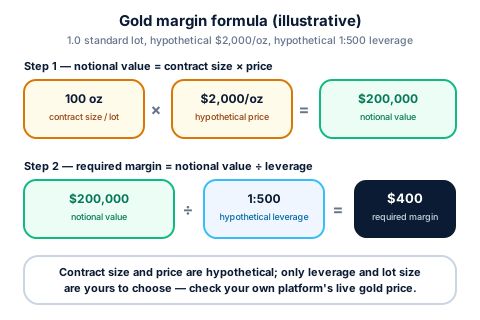
Required margin = (Lot size × Contract size × Price) ÷ Leverage
This is exactly the same formula used for any instrument — see our contract size, lot size, and margin explained guide for the general version, with worked examples on forex, indices, and oil. What's specific to gold is only the contract-size input: a standard gold lot commonly represents 100 troy ounces, a convention set by each broker rather than a universal standard, and different from a forex pair's 100,000-unit lot. If you haven't read the contract-size guide yet, it's worth doing first — this article doesn't repeat that explanation, only applies it to gold.
Worked example: 1.0 lot of gold at a hypothetical price
Take a clearly hypothetical gold price of $2,000 per troy ounce, with a 100 oz contract size per standard lot:
- Notional value = 100 oz × $2,000 = $200,000 for 1.0 lot. This is the real market exposure the position controls — the dollar amount actually moving with the market — and it doesn't change no matter what leverage you choose.
- Required margin at 1:500 leverage = $200,000 ÷ 500 = $400.
- Required margin at 1:100 leverage = $200,000 ÷ 100 = $2,000.
The position itself — its exposure to a move in gold's price — is identical in both cases. Only the amount of your own capital the broker sets aside as collateral changes, which is exactly the distinction our general forex leverage and margin explained guide covers in full, including margin level, margin calls, and stop-outs — this article doesn't re-derive those mechanics, only the gold-specific margin number that feeds into them.
Required margin by leverage and lot size (hypothetical $2,000/oz)
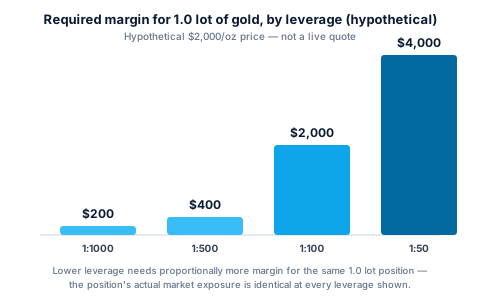
Using the same hypothetical $2,000/oz price, here's required margin at common leverage levels, for the three lot sizes most traders actually use:
| Leverage | 1.0 lot (100 oz) | 0.1 lot (10 oz) | 0.01 lot (1 oz) |
|---|---|---|---|
| 1:1000 | $200 | $20 | $2 |
| 1:500 | $400 | $40 | $4 |
| 1:200 | $1,000 | $100 | $10 |
| 1:100 | $2,000 | $200 | $20 |
| 1:50 | $4,000 | $400 | $40 |
Every figure in this table scales from the same $200,000 notional value for 1.0 lot — divide by 10 for 0.1 lot, by 100 for 0.01 lot, and divide the notional value by whatever leverage your account actually offers. At a different real-world gold price, every number in this table moves proportionally, since price is a direct multiplier in the formula. Run the same table with your platform's live price and your own account's leverage rather than treating these hypothetical figures as current.
Why leverage on gold isn't always your account's headline number
Gold's own contract specification on any given platform can set leverage differently from the "up to 1000:1" or similar figure advertised for forex pairs on the same account — some brokers cap metals at a separately lower maximum, and some also reduce available leverage temporarily around high-impact news, when gold's spread and volatility both tend to widen. Neither of these is universal, and it isn't something this article can confirm for every broker.
Our XM leverage explained guide covers XMTrading's own published, equity-based leverage tiers in detail — those tiers apply account-wide rather than singling out gold with a separate published cap, but the general point stands for any broker: check the actual leverage available on gold specifically, in your platform's contract specification, rather than assuming your account's advertised maximum leverage carries over to every instrument unchanged.
Margin isn't the same question as risk
A smaller required margin at higher leverage doesn't mean a smaller loss is possible on the same position — the notional value, and therefore the dollar impact of a given price move, is unchanged by leverage, exactly as shown in the worked example above. What leverage actually changes is how close a given position sits to a margin call or stop-out for a given account balance, since less of your equity is tied up as used margin at higher leverage, leaving a different cushion above those thresholds. The full mechanics — margin level, margin call thresholds, and stop-out — are covered in our forex leverage and margin explained guide, and gold's spread can widen sharply around volatile, risk-off market moves (see our gold trading costs explained guide for that side of gold specifically) — a factor that affects your actual trading cost and price risk independently of the margin calculation in this article.
Does margin affect your cashback?
No. CB-Dogs cashback is calculated on qualifying closed lot volume — the lot size you actually traded and closed, subject to the same minimum holding-time rule applied to every instrument — not on the margin a position used, the leverage it was opened at, or the notional value it controlled. A 1.0 lot gold position opened at 1:50 leverage and the same 1.0 lot position opened at 1:1000 leverage earn identical cashback, because the rebate is set per lot, per account type, independent of how the position's margin happened to be structured. Our gold cashback per lot explained guide covers how the per-lot rebate itself works, including why gold's rate can differ from a forex pair's depending on your broker's calculation model.
| Account type | Rebate / lot (USDT) |
|---|---|
| StandardSpread-based account, no commission. | 9.0 |
| MicroRebate is calculated per 100,000 units of micro-lot volume (i.e. the same per-lot rate as Standard, scaled to micro-lot size). | 9.0 |
| KiwamiXM's tightened-spread account tier available in select regions. | 6.0 |
| ZeroCommission-based account. Rebate is paid in addition to the raw spread — commission you pay is unaffected. | 4.5 |
Provisional rate
Frequently asked questions
It depends on the current gold price and your account's leverage: required margin = (1.0 lot × 100 oz contract size × current price) ÷ leverage. Using a hypothetical $2,000/oz price, that's roughly $400 at 1:500 leverage or $2,000 at 1:100 leverage — plug in your platform's live price and your own leverage for an accurate figure.
Related reading
- Contract size, lot size, and margin explained — the general formula this article applies specifically to gold.
- Forex leverage and margin explained — margin level, margin calls, and stop-out mechanics in full.
- Gold (XAU/USD) trading costs explained — spread, commission, and swap on gold, separate from the margin question in this guide.
- Gold (XAUUSD) cashback explained — how the per-lot rebate works and why it doesn't depend on margin or leverage.
- XM leverage explained — XMTrading's own published, equity-based leverage tiers.
- XM broker page — live cashback rates by account type, including gold.
Work out your own numbers
Check your own platform's live gold price and current leverage, then plug both into the formula above alongside the lot size you're considering. To see how qualifying gold volume adds up over time, try the cashback calculator, or register with CB-Dogs before your next trade.
Risk warning: forex and CFD trading carries a high risk of losing money. Cashback does not offset trading losses. Nothing here is investment advice.
Related articles
Cashback on your XM trades — free, paid in USDT
Sign up free