What Does 'Commission Per Million' Mean? Converting It to Per Lot
A commission quoted "per million" charges a fixed amount per $1,000,000 of notional trading volume rather than per lot; converting it to a per-lot figure means dividing the per-million rate by 1,000,000 and multiplying by the notional value of the lot you're actually trading.
By CB-Dogs Editorial4 min read
Disclosure: CB-Dogs receives an advertising (referral) fee — sometimes called an IB commission — from brokers for accounts opened or linked through us, and returns part of it to you as cashback, the same model used by cashback and points sites. This does not change your trading costs.
On this page
- What "per million" means
- The conversion formula
- A worked example
- Reverse conversion: per-lot back to per-million
- Why the same "per million" rate gives a different per-lot cost on different pairs
- Quick reference: per-million to per-lot, assuming a round $100,000 notional
- Round turn or per side? The same question applies
- Frequently asked questions
- Next steps
Some brokers and IB reporting tools quote commission "per million" instead of "per lot" — a convention borrowed from institutional and ECN-style pricing, where cost is naturally expressed against notional volume rather than a retail lot size. If you've seen a "$45 per million" figure and aren't sure what it means for your own trade size, this guide gives the exact conversion.
Key takeaways
- A "per million" commission quote charges a fixed dollar amount per $1,000,000 of notional trading volume, not per lot.
- Converting to a per-lot figure requires the notional value of the lot you're trading: Commission per lot = (Commission per million ÷ 1,000,000) × Notional value of the lot.
- Notional value of a standard forex lot is 100,000 units of the base currency, which needs converting to USD at the current exchange rate if the base currency isn't already USD.
- The same per-million rate produces a different per-lot cost on different pairs, since each pair's notional value in USD differs.
- Whether a per-million quote is round-turn or per-side follows the same convention question covered for per-lot commission quotes — always confirm which one applies before comparing numbers.
What "per million" means
"Per million" pricing is common in institutional and some ECN/raw-spread pricing, where cost is naturally quoted against notional trading volume — the total dollar value actually transacted — rather than a retail-style "per lot" figure. A $50 per million commission means $50 is charged for every $1,000,000 of notional volume traded, regardless of how many individual lots that volume happens to be split across.
The conversion formula
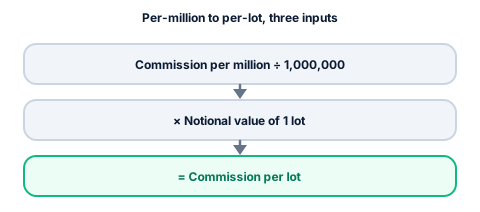
Commission per lot = (Commission per million ÷ 1,000,000) × Notional value of 1 lot.
The only variable is the notional value of the lot you're actually trading, which depends on the pair:
- A standard lot is 100,000 units of the base currency — the first currency in the pair.
- If the base currency is USD (as in USD/JPY or USD/CAD), the notional value is already $100,000, no conversion needed.
- If the base currency isn't USD (as in EUR/USD or GBP/USD), the 100,000 units of base currency need converting to USD at the current exchange rate — see how brokers calculate commission on non-USD accounts for the same underlying conversion step applied to a different commission format.
A worked example
Assume a broker quotes $50 per million, round turn, and you trade 1.0 standard lot of EUR/USD with the illustrative EUR/USD rate at 1.10.
- Notional value of 1.0 lot: 100,000 EUR × 1.10 = $110,000.
- Commission per lot: ($50 ÷ 1,000,000) × $110,000 = $5.50 (round turn, for the full closed trade).
If the same broker instead quoted the identical real cost as "per lot," it would show up as $5.50 round turn — the two numbers describe the same underlying cost, just expressed against a different unit of volume.
All figures here are rounded, illustrative assumptions used to demonstrate the conversion, not a real broker's published rate.
Reverse conversion: per-lot back to per-million
The same formula runs in reverse, useful when you want to compare a per-lot quote against a per-million one:
Commission per million = (Commission per lot ÷ Notional value of 1 lot) × 1,000,000.
Using the example above: ($5.50 ÷ $110,000) × 1,000,000 = $50.00 per million — confirming the two figures match.
Why the same "per million" rate gives a different per-lot cost on different pairs
Because the formula multiplies by notional value, and notional value in USD differs by pair (and shifts with the exchange rate for any pair not already denominated in USD), the identical "$50 per million" quote produces a different per-lot dollar figure on EUR/USD than on, say, AUD/USD at a different rate. This is the same underlying idea covered in pip value for major pairs and gold — a fixed rate applied to a variable, pair-dependent input doesn't produce a fixed output.
Quick reference: per-million to per-lot, assuming a round $100,000 notional
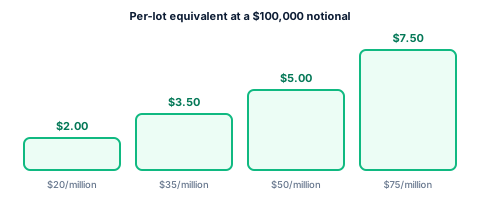
For simplicity, using a rounded $100,000 notional lot (roughly a USD-base pair, or EUR/USD near parity):
| Per-million quote | Equivalent per-lot cost |
|---|---|
| $20 | $2.00 |
| $35 | $3.50 |
| $50 | $5.00 |
| $75 | $7.50 |
Recalculate with your pair's actual notional value (Step 1 above) for an accurate figure — this table exists to show the linear scaling, not to replace the calculation for your specific trade.
Round turn or per side? The same question applies
A "per million" quote can be round turn (covering the full closed trade) or per side (charged once on opening, once on closing) — exactly the same distinction covered in commission per lot: round turn vs. per side. Confirm which convention a "per million" quote uses before comparing it against another broker's figure, for the same reason a per-lot quote requires the same check.
Frequently asked questions
It's a convention borrowed from institutional and ECN-style pricing, where cost is naturally tied to notional volume traded rather than a retail lot-size unit. Some IB and prime-of-prime reporting also uses this format because it matches how volume is aggregated across accounts.
Next steps
Convert your own broker's commission quote using the formula above, then see how it fits into your total trading cost with how to calculate your real monthly forex trading cost, or register with CB-Dogs to start earning cashback on your qualifying volume.
Risk warning: forex and CFD trading carries a high risk of losing money. Cashback does not offset trading losses. Nothing here is investment advice.
Related articles
Cashback on your XM trades — free, paid in USDT
Sign up free