How to Evaluate a Forex Cashback Program (Without Just Trusting the Rate)
The best forex rebate program for you is the one that's transparent about how its rate is calculated, pays in a method and on a schedule you can actually verify, discloses its IB relationship with the broker, and doesn't quietly change your trading conditions — not necessarily the one advertising the single highest headline number.
By CB-Dogs Editorial6 min read
Disclosure: CB-Dogs receives an advertising (referral) fee — sometimes called an IB commission — from brokers for accounts opened or linked through us, and returns part of it to you as cashback, the same model used by cashback and points sites. This does not change your trading costs.
On this page
- Start with the calculation method, not the number
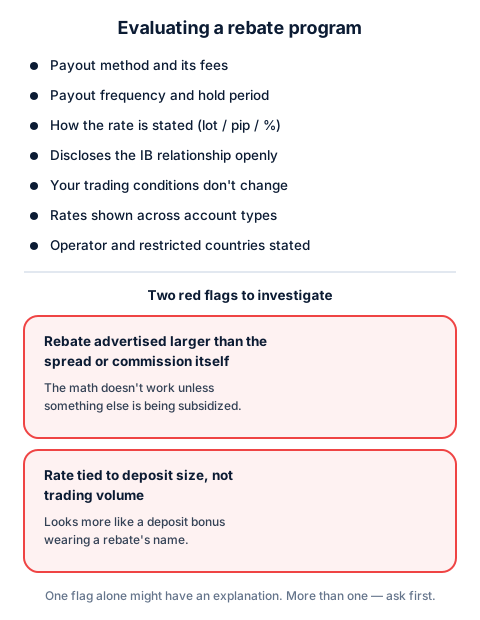
- Payout method and fees
- Payout frequency and hold periods
- Transparency of the IB relationship
- Does your trading condition actually change?
- Supported brokers and account types
- Operator disclosure and restricted countries
- Red flags worth investigating before you sign up
- Putting it together: a comparison, not a verdict
- Frequently asked questions
- Related reading
Search "best forex rebate program" and you'll find a dozen sites each claiming the title, usually backed by a single "up to $X per lot" number. That number alone doesn't tell you much — it depends entirely on the broker, the account type, and how the rate is calculated in the first place. This is a practical way to compare programs on the things that actually determine what you'll receive, not just the headline.
Key takeaways
- A single headline rate can't tell you which program is actually better — the broker, account type, and calculation method behind it matter more than the number itself.
- Check the payout method and its fees, the payout frequency and any hold period, and whether the rate is quoted per lot, in pips, or as a percentage before comparing across programs.
- A program should openly disclose that it's an Introducing Broker (IB) sharing part of a broker-paid advertising fee — vague language about where the money comes from is a bigger concern than the fee itself.
- A rebate should never require your trading conditions to change, and a rate advertised as larger than the spread itself, or tied to your deposit size, is a red flag worth investigating before signing up.
- This article covers comparison criteria, not a legitimacy/scam check — see our separate checklist for verifying that a provider is trustworthy in the first place.
Start with the calculation method, not the number
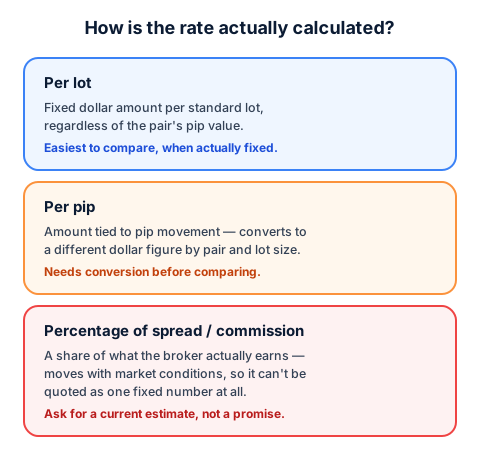
Rebate rates are stated in at least three different ways, and they aren't directly comparable to each other without doing the conversion yourself:
- Per lot — a fixed dollar amount per standard lot traded, regardless of the pair's pip value. This is the easiest to compare broker-to-broker, when it's actually fixed (see below).
- Per pip — an amount tied to pip movement, which converts to a different dollar figure depending on the pair and the lot size.
- Percentage of spread or commission — a share of what the broker actually earns on your trade, which means the dollar figure moves with market conditions and can't be quoted as a single fixed number at all. Our per-lot vs. percentage cashback guide covers the mechanics of this difference in more depth.
A program that publishes a rate table broken down by broker and account type — rather than one number in marketing copy — is telling you it's using a method you can actually verify. A program that only ever shows "up to $X" without saying per what, on what account type, is asking you to trust a best case rather than compare a real one.
Payout method and fees
How you're actually paid matters as much as the rate itself. Bank transfer, e-wallets, and crypto payouts all carry different fee structures, minimums, and — in the case of crypto — a specific network you need to get right. Ask: what's the payout method, is there a minimum withdrawal amount, is there a fee below some threshold, and does that fee structure actually get disclosed up front rather than only after you've signed up?
Payout frequency and hold periods
A rebate isn't available the instant you close a trade. Every broker takes time to confirm and pay the underlying commission to the IB, and most IBs add their own review period before releasing funds to you — a hold period. A program that states this clearly (a specific number of days from trade to withdrawable balance, by broker) is giving you something you can plan around; one that just says "fast payouts" without a number is asking you to find out the hard way.
This isn't a flaw specific to any one provider — it's a structural feature of how IB commissions flow from broker to provider to you, and every honest program has some version of it. What varies is whether it's disclosed in writing, and whether it differs by broker in ways that are stated up front rather than discovered at withdrawal time.
Transparency of the IB relationship
A cashback program exists because brokers pay Introducing Brokers an advertising (referral) fee for referring active traders, and the program shares most of that fee back with you. A program that states this openly — rather than describing itself vaguely as "we help traders save money" without saying how — is telling you something checkable. This overlaps with, but is distinct from, verifying that a provider is legitimate in the first place; our dedicated guide to verifying a forex cashback provider is legitimate covers that scam-check angle (payout proof, independent reviews, and red flags) in full — this article is about comparing programs you've already decided are trustworthy candidates.
Does your trading condition actually change?
A rebate is a partial refund of costs you already paid — it should never come attached to a different spread, a wider markup, or a separate "cashback account type" with worse trading conditions than the broker's normal offering. If a program requires you to trade through a specific account type that isn't otherwise identical to what you'd get signing up directly, that's a cost worth weighing against the rebate itself, not a detail to skip past.
Supported brokers and account types
A rate that applies only to one narrow account type isn't the same offer as a rate that applies broadly. Check whether the program publishes rates across every account type a broker offers, or only its best-case one — and whether the brokers it supports are ones you'd actually choose to trade with on their own merits, rather than picking a broker because a rebate site happens to cover it.
It's also worth checking whether the program treats every account type the same way. Some account types are commission-based (a disclosed fee alongside a tighter spread) rather than spread-only, and the rebate calculation can differ between the two even on the same broker — a program that only shows one representative account type is hiding that difference rather than explaining it.
Operator disclosure and restricted countries
A program should be clear about who operates it and where — not necessarily a full corporate filing, but enough that you know who you're dealing with and how to reach them. Just as important on the other side: whether the program is actually available to you. A legitimate operator will state which countries it can't serve (due to the broker's own regulatory restrictions, not the provider's preference) rather than letting you sign up and find out later that your trading was never eligible. See our eligibility page for how CB-Dogs states this for its own program.
Red flags worth investigating before you sign up
Neither pattern automatically means a program is dishonest, but both are worth a direct question to the provider before you commit: exactly how is this rate calculated, and from what underlying broker payment?
Putting it together: a comparison, not a verdict
None of this produces a single "best" program, because the right one depends on which broker and account type you actually trade on, which payout method suits you, and how much you weigh a short hold period against a slightly higher headline rate. Two programs can both be legitimate and transparent while suiting different traders — the point of this checklist is to compare them on the same terms rather than on whichever one shouts its number the loudest.
CB-Dogs doesn't claim to be the single best program for every trader — only that our rate table, payout terms, and IB disclosure are things you can check yourself before registering, and that our rate is calculated from the real commission we receive, not a marketing figure. Run the criteria above against any program, including this one.
Frequently asked questions
Not necessarily. A higher headline number can reflect a different account type, a temporary promotion, or a calculation method (like a percentage of spread) that isn't directly comparable to a fixed per-lot rate elsewhere. Compare the actual rate for your specific broker and account type, not just the biggest number you see.
Related reading
- How to verify a forex cashback provider is legitimate — the separate scam-check angle: IB disclosure, payout proof, and independent reviews.
- Per-lot vs. percentage cashback: how rebate calculations differ — the mechanics behind the three rate-statement methods above.
- How forex rebates work — the underlying IB commission flow every rebate program depends on.
- Forex rebates paid in USDT — how CB-Dogs' own payout method and fee structure work end to end.
- Forex rebate vs. deposit bonus — why a deposit-tied "rebate" is structurally closer to a bonus.
- Forex broker withdrawal methods and fees explained — checking the broker's own withdrawal process, separate from any rebate program's payout track record.
Risk warning: forex and CFD trading carries a high risk of losing money. Cashback does not offset trading losses. Nothing here is investment advice.
Related articles
Cashback on your XM trades — free, paid in USDT
Sign up free