What Is a Pip in Gold, Silver, and Oil? Contract Sizes Compared
Gold, silver, and oil don't share one 'pip' convention: each is typically quoted in price points with its own contract size, so the same-looking price move is worth a different dollar amount in each market — always check your own platform's contract specification before assuming a figure.
By CB-Dogs Editorial4 min read
Disclosure: CB-Dogs receives an advertising (referral) fee — sometimes called an IB commission — from brokers for accounts opened or linked through us, and returns part of it to you as cashback, the same model used by cashback and points sites. This does not change your trading costs.
On this page
- Why "pip" doesn't quite apply to commodities
- Gold (XAU/USD): contract size and point value
- Silver (XAG/USD): contract size and point value
- Oil (WTI/Brent): contract size and tick value
- Worked examples: comparing a point move across three instruments
- Why this matters for position sizing and cost
- How this connects to cashback rebates
- Frequently asked questions
- Next steps
"Pip" is a forex term, and it doesn't translate cleanly to gold, silver, or oil. Each of these markets is typically quoted in price "points" or "ticks" instead, and — unlike forex, where a standard lot is reliably 100,000 units of the base currency — the contract size behind a lot differs from instrument to instrument and sometimes from platform to platform. This guide compares the three so you're not assuming a forex-style number applies where it doesn't.
Key takeaways
- "Pip" is a forex-specific term; gold, silver, and oil are more commonly quoted in price "points" or "ticks," and the dollar value of one tick differs by instrument.
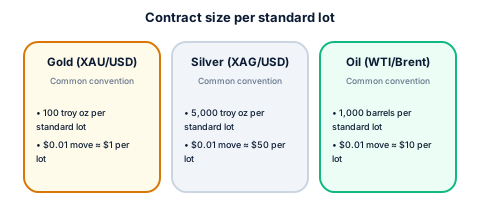
- Gold (XAU/USD) commonly uses a contract size of 100 troy ounces per standard lot, so a $0.01 price move is worth roughly $1 per lot under that convention.
- Silver (XAG/USD) commonly uses a much larger contract size — 5,000 troy ounces per standard lot is a widely used convention — so its per-tick dollar value differs substantially from gold's even at a similar percentage move.
- Oil (WTI/Brent CFDs) is usually quoted per barrel with its own contract size, commonly 1,000 barrels per standard lot, making a $0.01 move worth a different amount again.
- None of these conventions are universal across brokers — confirm the exact contract size, tick size, and tick value in your own platform's contract specifications before sizing a position.
Why "pip" doesn't quite apply to commodities
A pip in forex is a defined, standardized unit — the fourth decimal place for most currency pairs, the second for JPY pairs — because currency prices are quoted as an exchange rate between two units of currency. Gold, silver, and oil are quoted differently: as a dollar price per unit of the underlying commodity (per troy ounce for metals, per barrel for oil). There's no equivalent standardized "pip" — instead, traders and platforms talk about a price "point" (usually the smallest quoted price increment) or a "tick," and what that increment is actually worth in dollars depends entirely on the contract size behind one lot.
If you've already read our guide to lot size, pip value, and spread cost, the underlying idea — contract size × price move = dollar value — is the same. What changes for commodities is the contract size itself, and it's worth working out for each instrument separately rather than assuming it matches a forex standard lot.
Gold (XAU/USD): contract size and point value
A widely used convention treats one standard lot of gold (XAU/USD) as 100 troy ounces. Under that convention, a $0.01 move in gold's price is worth $1 per standard lot (100 oz × $0.01), and a full $1.00 move is worth $100 per standard lot. Some platforms instead define their smallest quoted increment directly as $0.10 or even $1.00 "points," which changes how a spread or a price move gets displayed on screen — the underlying $-per-ounce math doesn't change, but the label on the smallest increment does.
Silver (XAG/USD): contract size and point value
Silver commonly uses a much larger contract size than gold — 5,000 troy ounces per standard lot is a widely used convention, reflecting silver's much lower price per ounce compared with gold. Under that convention, a $0.01 move in silver's price is worth $50 per standard lot (5,000 oz × $0.01) — fifty times gold's per-tick dollar value for the same nominal price move, purely because of the larger contract size. This is exactly why comparing "pip value" across metals by price movement alone is misleading: the contract size matters as much as the price change itself.
Oil (WTI/Brent): contract size and tick value
Oil CFDs are quoted per barrel, and a common convention sizes one standard lot at 1,000 barrels. Under that convention, a $0.01 move in the oil price is worth $10 per standard lot (1,000 barrels × $0.01). Some platforms quote oil in smaller "mini" or "micro" lot sizes by default given oil's higher typical volatility in dollar terms, so the effective per-tick value you see on your own platform can differ from this convention.
Worked examples: comparing a point move across three instruments
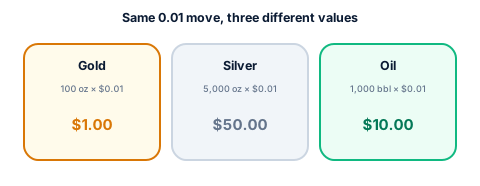
Assume, purely for illustration, that gold, silver, and oil each move by $0.01 in the same session, and you're holding one standard lot of each under the conventions above:
- Gold: 100 oz × $0.01 = $1.00
- Silver: 5,000 oz × $0.01 = $50.00
- Oil: 1,000 barrels × $0.01 = $10.00
The identical-looking $0.01 move produces three completely different dollar outcomes, purely because of contract size. This is why a "pip value" figure from one commodity should never be assumed to carry over to another — or even to the same commodity on a different platform.
Why this matters for position sizing and cost
Position sizing formulas — like the risk-based approach in our position size from risk guide — depend on knowing the dollar value of a price move for your instrument. Get the contract size wrong for gold, silver, or oil, and a position you think risks $50 could actually risk $500 or $5,000. The same logic applies to reading a spread: a "20-point" spread means something completely different in dollar terms across these three markets, similar to how pips and points differ in forex quoting. For a fuller breakdown of gold's trading costs specifically, see our gold (XAU/USD) trading costs guide. Crypto CFDs raise a similar contract-size question of their own — see what is a pip in crypto CFDs vs. forex for how that comparison works.
How this connects to cashback rebates
Cashback rebates are calculated on qualifying closed lot volume, the same way regardless of which instrument you traded — gold, silver, oil, or a currency pair. The pip-or-point value questions above affect your trading cost and position sizing, not how a rebate itself is calculated; see how forex rebates work for the underlying mechanics. Run the cashback calculator with your own typical lot volume across whatever instruments you trade.
Frequently asked questions
No. Gold is usually quoted in price points rather than a standardized pip, and the dollar value of one point depends on gold's contract size (commonly 100 troy ounces per standard lot), not on a fixed fourth-decimal-place convention like forex.
Next steps
Check your own platform's contract specifications before sizing a position in gold, silver, or oil, and see our lot, pip, and spread cost guide for the equivalent forex-pair math. Register with CB-Dogs before opening or linking your broker account so qualifying volume across any instrument starts earning cashback from the start.
Risk warning: forex and CFD trading carries a high risk of losing money. Cashback does not offset trading losses. Nothing here is investment advice.
Related articles
Cashback on your XM trades — free, paid in USDT
Sign up free