Spread in Pips vs. Points: What 5-Digit Pricing Actually Means
A pip is the standard fourth decimal place in most currency pairs; a point (or pipette) is a tenth of a pip added by finer 5-digit pricing — a spread of 12 points and a spread of 1.2 pips describe the exact same real cost, just in different units.
By CB-Dogs Editorial4 min read
Disclosure: CB-Dogs receives an advertising (referral) fee — sometimes called an IB commission — from brokers for accounts opened or linked through us, and returns part of it to you as cashback, the same model used by cashback and points sites. This does not change your trading costs.
On this page
Two platforms can quote the exact same real spread and display two completely different-looking numbers — one showing "1.2" and the other showing "12" — simply because they use different units. This guide explains pips, pipettes, and points, why 5-digit pricing exists, and how to convert between them so a comparison actually means something.
Key takeaways
- A "pip" is the standard fourth decimal place for most currency pairs (the second decimal for JPY pairs); a "point" or "pipette" is a tenth of a pip, added by finer 5-digit (or 3-digit for JPY) pricing.
- A spread quoted as "12 points" on a 5-digit platform is the same real cost as "1.2 pips" — always check which unit your platform's spread display actually uses.
- Converting is simple: divide a points figure by 10 to get pips, or multiply a pips figure by 10 to get points, for standard 5-digit/3-digit quoting.
- Comparing spreads across two brokers or platforms only works once both are converted to the same unit — a smaller "points" number can look artificially cheap next to a broker quoting in pips.
- The actual dollar cost of a spread still depends on pip value and lot size, not on which unit label the number is displayed in.
Pip, pipette, and point: what each term means
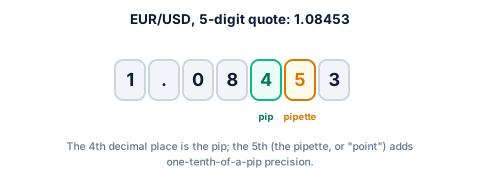
A pip ("percentage in point") is the standard unit of price movement for most currency pairs — the fourth decimal place for pairs like EUR/USD (0.0001) and the second decimal place for JPY pairs (0.01), because of how those pairs are conventionally quoted. A pipette, sometimes just called a point, is one-tenth of a pip — the fifth decimal place for most pairs, or the third for JPY pairs. It exists purely for pricing precision: it lets a broker display a spread or a price more finely than whole pips allow.
Why some platforms show 5 digits instead of 4
Older-style forex quoting used 4 decimal places for most pairs (2 for JPY pairs), so a EUR/USD quote might read 1.0850. Many modern platforms instead quote 5 decimal places (3 for JPY pairs) — 1.08503 — adding that extra pipette/point digit. This didn't change what a pip is; it just lets the platform express a spread or a price move with finer granularity, which matters more on tightly priced raw-spread or ECN-style accounts where a spread might genuinely sit between two whole pip values.
Converting between pips and points
Because a point (pipette) is one-tenth of a pip under this common convention, converting between the two is straightforward:
- Points → pips: divide by 10 (120 points = 12.0 pips)
- Pips → points: multiply by 10 (1.2 pips = 12 points)
This holds for standard 5-digit (or 3-digit JPY) quoting. If a platform's spread display already shows a decimal pip value directly (like "1.2 pips"), no conversion is needed — the confusion mostly arises when one source quotes a whole-number "points" figure and another quotes a decimal "pips" figure for what is, underneath, the identical spread.
Worked example: same spread, two different displays
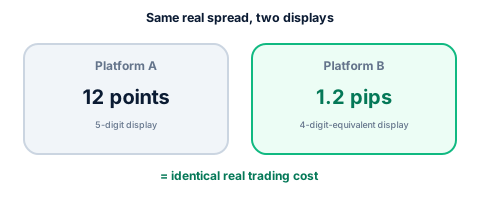
Suppose Platform A displays EUR/USD's spread as "12 points", and Platform B displays what is actually the identical real spread as "1.2 pips". Read at face value without converting, "12" might look ten times more expensive than "1.2" — but they describe the exact same cost. Converting Platform A's figure (12 points ÷ 10 = 1.2 pips) confirms the two are identical before you draw any conclusion about which platform is cheaper.
Why this trips up broker comparisons
This unit confusion shows up most often when comparing marketing material or spread tables between brokers that use different display conventions, or when reading a broker's own historical spread data alongside a third-party comparison site. It's the same category of comparison trap as the one covered in our commission per lot: round turn vs. per side guide — two numbers that look different can represent an identical real cost, and two numbers that look the same can represent very different real costs, depending on the unit or convention behind them. Always convert both figures to the same unit before comparing, and see our lot, pip, and spread cost guide for turning a converted pip spread into an actual dollar cost.
How this connects to spread cost and rebates
Once you've converted a spread to a consistent pip figure, the dollar cost calculation is the same as in our lot and spread cost guide: spread cost = spread (in pips) × pip value per lot × lots. Cashback rebates are calculated on qualifying closed lot volume, independent of which unit a platform happens to display its spread in — see how forex rebates work for the underlying mechanics, and our raw spread vs. standard account guide for how spread and commission trade off against each other once everything is in the same unit. Whether a spread is quoted in pips or points, it can also be either fixed or variable, which affects cost predictability separately from the display unit. Crypto CFDs add another wrinkle, since they usually skip pip and point conventions altogether — see what is a pip in crypto CFDs vs. forex for that comparison.
Frequently asked questions
In most forex spread displays, yes — that's the pipette convention this article uses. But "point" is used inconsistently across the industry and can mean something different on other instrument types (like gold, silver, or oil), so always confirm your own platform's definition.
Next steps
See our lot, pip, and spread cost guide for turning a converted spread into a dollar cost, and our how to compare two brokers' total cost with rebates included guide for factoring cashback into the comparison. Register with CB-Dogs before opening or linking your broker account so qualifying volume starts earning cashback from the start.
Risk warning: forex and CFD trading carries a high risk of losing money. Cashback does not offset trading losses. Nothing here is investment advice.
Related articles
Cashback on your XM trades — free, paid in USDT
Sign up free