Fixed vs. Variable (Floating) Spreads Explained
A fixed spread is set to stay the same regardless of market conditions, while a variable (floating) spread widens and narrows with liquidity — fixed spreads trade predictability for an often-wider everyday baseline, while variable spreads trade a often-tighter baseline for occasional widening around news or thin liquidity.
By CB-Dogs Editorial6 min read
Disclosure: CB-Dogs receives an advertising (referral) fee — sometimes called an IB commission — from brokers for accounts opened or linked through us, and returns part of it to you as cashback, the same model used by cashback and points sites. This does not change your trading costs.
On this page
- The short answer
- Where each type is typically offered
- How each behaves over a trading day
- A worked, illustrative comparison
- Which one is "better"
- How this looks for a few specific trading styles
- Why "as low as" advertising usually describes a variable spread
- Does the spread type affect a rebate?
- Related reading
- Frequently asked questions
- Work out your own numbers
Our guide to lot, pip, and spread cost covers how spread cost is calculated once you know the number in pips. This article covers a question that comes before that: why the spread number itself isn't always the same kind of thing across brokers and account types, since some are labelled "fixed" and others "variable" (or "floating").
Key takeaways
- A fixed spread is set by the broker to stay constant regardless of current market liquidity; a variable (floating) spread moves with market conditions in real time.
- Variable spreads are the more common structure on modern retail accounts, especially raw-spread or ECN-style accounts that pass through a live market feed.
- Fixed spreads trade predictability for an often-wider everyday baseline cost; variable spreads trade a often-tighter everyday baseline for occasional widening around news or thin liquidity.
- "Fixed" doesn't always mean a spread can never change under any circumstance — some brokers reserve the right to widen even a nominally fixed spread during extreme volatility, so check the specific terms.
- Neither spread type changes how a cashback rebate is calculated, since a rebate is based on qualifying closed lot volume, not on which spread structure produced the underlying cost.
The short answer
A fixed spread stays the same number of pips regardless of current market conditions, at least under normal circumstances. A variable (floating) spread widens and narrows continuously, tracking the underlying market's actual liquidity at each moment — tighter when many participants are quoting, wider when fewer are, as covered in general terms in our guide to when spreads widen.
Where each type is typically offered
Variable spreads are the dominant structure across most of the retail industry today, and are close to universal on raw-spread or ECN-style accounts, which pass through a live, continuously-updating market price feed, as covered in our raw spread vs. standard accounts guide and market maker vs. ECN vs. STP brokers guide. A fixed spread is more associated with a dealing-desk or market-maker execution model, where the broker itself sets the quoted price rather than passing through a live feed unmodified — this gives the broker the ability to hold a spread constant, at a cost of typically setting it wider on average than a comparable variable spread's typical (non-widened) level, to cover the broker's own risk of quoting a stale price during a fast move.
How each behaves over a trading day
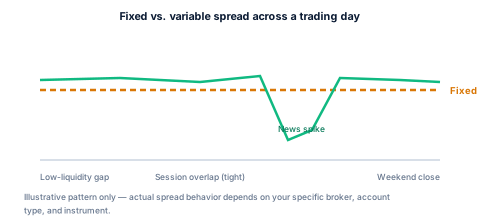
A variable spread's defining feature is that it isn't one number — it's a range that narrows during high-liquidity hours (particularly session overlaps, as covered in our trading sessions guide) and widens during thin liquidity or around scheduled high-impact news, a pattern covered further in our guide to how news trading affects your trading costs. A fixed spread, by design, doesn't follow that pattern under normal conditions — the number quoted at 3 a.m. during the daily low-liquidity gap is nominally the same as the number quoted during the London-New York overlap.
A worked, illustrative comparison
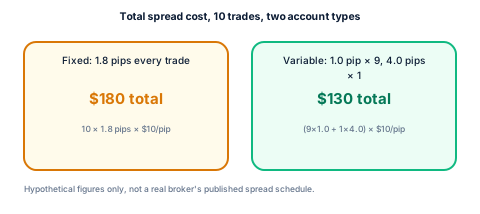
Illustrative inputs: 10 trades of 1.0 lot each, $10 per pip.
- Fixed spread account: a constant 1.8 pips on every trade = 10 × 1.8 × $10 = $180 total spread cost.
- Variable spread account: 1.0 pip on nine trades placed during typical liquidity, and 4.0 pips on one trade placed around scheduled news = (9 × 1.0 × $10) + (1 × 4.0 × $10) = $90 + $40 = $130 total spread cost.
In this particular illustrative scenario, the variable-spread account comes out cheaper overall despite one notably wide trade, because its typical (non-widened) baseline is tighter than the fixed account's constant number. A trader who places most or all of their trades during the exact moments a variable spread widens would see the comparison shift — which is precisely the trade-off: fixed spreads remove that timing risk entirely, at the cost of a higher everyday baseline.
Which one is "better"
Neither structure is universally cheaper — it depends on your own trading pattern. A trader who frequently places market orders around scheduled news, or trades during known thin-liquidity windows, has more to gain from a fixed spread's predictability. A trader who avoids those specific windows, or who values a tighter everyday baseline over occasional widening, is more likely to come out ahead on a typical variable-spread account. This is the same kind of trade-off, applied to spread type specifically, that our broader guide to comparing broker total cost with rebates covers for account and broker comparisons generally.
How this looks for a few specific trading styles
- Part-time traders, covered in our forex trading costs for part-time traders guide, place relatively few trades a month, so a single unlucky wide moment on a variable spread matters proportionally more to their overall cost than it would for a high-frequency trader averaging across hundreds of fills.
- EA and algo traders, covered in our forex trading costs for EA and algo traders guide, often care specifically about spread predictability for backtesting and live-performance matching — a variable spread that widens unpredictably around news can throw off a strategy tuned on historical average-spread assumptions, which is one reason some EA-focused traders specifically seek out accounts with tighter, more stable typical spreads rather than a nominally "fixed" number that can still widen in extreme conditions.
- Scalpers, covered in our forex rebates for scalpers guide, are usually most sensitive to the everyday baseline spread rather than occasional widening, since a scalping strategy places many trades across ordinary market hours rather than specifically around news — this typically favors a tight variable spread over a wider fixed one, all else equal.
Why "as low as" advertising usually describes a variable spread
A broker's marketing page advertising a headline spread figure ("spreads from 0.0 pips") is almost always describing the tightest point on a variable spread's range, typically for one specific major pair under favorable liquidity conditions — not a guaranteed, constant number you'll see on every trade. A genuinely fixed spread, by contrast, is usually disclosed as a single flat figure in the account's own contract specification rather than an "as low as" range, since there's no range to describe. If you see a spread advertised as a range or a "from" figure, that's itself a signal the underlying structure is variable, even before you check the account specification directly.
Does the spread type affect a rebate?
No. A cashback rebate is calculated on qualifying closed lot volume, as explained in our guide to how forex rebates work — it has no connection to whether the spread on a given trade was fixed or variable, or how wide it happened to be at that moment.
Related reading
- Forex trading sessions and when spreads widen — the liquidity mechanics behind a variable spread's behavior over a trading day.
- Raw spread vs. standard account: which is cheaper? — how account type interacts with spread structure and commission.
- Market maker vs. ECN vs. STP brokers — the execution models most associated with fixed and variable spreads respectively.
Frequently asked questions
A fixed spread is set to stay the same number of pips regardless of market conditions, under normal circumstances. A variable (floating) spread moves continuously, narrowing during high liquidity and widening during thin liquidity or around news.
Work out your own numbers
Check your own account type's contract specification to see whether it uses a fixed or variable spread, and compare your typical trading pattern against the trade-offs above. To see how qualifying volume adds up under either structure, try the cashback calculator, or register with CB-Dogs before your next trade.
Risk warning: forex and CFD trading carries a high risk of losing money. Cashback does not offset trading losses. Nothing here is investment advice.
Related articles
Cashback on your XM trades — free, paid in USDT
Sign up free