Forex Trading Costs for Part-Time Traders: Why Small Volume Changes the Math
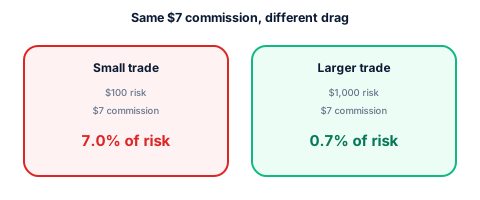
The cost formulas (spread, commission, swap) don't change for a part-time trader, but the same dollar amounts represent a bigger share of a small number of trades, and low volume also means fewer total cashback dollars and a slower path to any minimum withdrawal threshold.
By CB-Dogs Editorial4 min read
Disclosure: CB-Dogs receives an advertising (referral) fee — sometimes called an IB commission — from brokers for accounts opened or linked through us, and returns part of it to you as cashback, the same model used by cashback and points sites. This does not change your trading costs.
On this page
- The formulas don't change — the denominator does
- Why fixed costs feel bigger at low volume
- Overnight swap: less frequent trades, more nights held (sometimes)
- The one number that matters regardless of volume: cost and rebate per lot
- A part-time trader's practical checklist
- Frequently asked questions
- Next steps
Most cost-of-trading articles are written with an active trader in mind — dozens of lots a month, frequent statements, fast-growing rebate totals. If you trade forex around a full-time job, closing a handful of lots a month, the underlying formulas are exactly the same, but the way they land on you is different. This guide works through why low volume changes the practical math, without changing the math itself.
Key takeaways
- Spread, commission, and swap formulas are identical for part-time and full-time traders — only the number of lots they get multiplied by differs.
- A cashback rebate is paid per qualifying closed lot, so trading fewer lots means fewer total rebate dollars even at the exact same per-lot rate as an active trader.
- Fixed thresholds (like a minimum withdrawal amount) take proportionally longer to reach on a low-volume account, which affects how you should plan payout timing.
- Overnight swap and any account-holding-related charges can matter more, relative to your trading activity, if positions are held longer between infrequent trades.
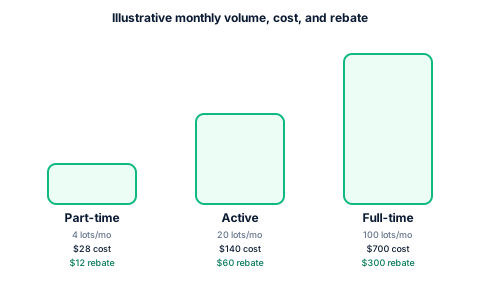
- The most useful comparison for a part-time trader isn't 'total monthly cost' but 'cost and rebate per lot' — that number doesn't change with how often you trade.
The formulas don't change — the denominator does
Spread cost, commission, and swap are all calculated the same way regardless of how often you trade: spread cost is spread (in pips) times pip value times lots, commission is a fixed amount per lot, and swap is a daily rate times lots times nights held. See lot, pip, and spread cost explained for the underlying formulas if you haven't seen them before.
What changes for a part-time trader is simply the number of lots those formulas get applied to. An active trader closing 40 lots a month and a part-time trader closing 4 lots a month pay the exact same cost per lot on the same account type — the part-time trader just has a smaller total bill, and a smaller total rebate, because there's ten times less volume behind it.
Why fixed costs feel bigger at low volume
Some costs behave less like a per-lot formula and more like a flat charge relative to your activity. A withdrawal fee is the clearest example: CB-Dogs charges a flat 3 USDT fee on withdrawals below 50 USDT, and no fee at 50 USDT or above. For an active trader whose monthly cashback comfortably clears 50 USDT, that fee rarely applies. For a part-time trader accumulating cashback slowly, it can take several months to clear that threshold, and withdrawing early or in small amounts means paying the flat fee on a proportionally smaller balance.
The same logic applies to any fixed platform or data cost a broker charges (inactivity fees on some account types, for instance — check your specific broker's current terms). A flat monthly charge is a rounding error against 40 lots of trading and a real drag against 4.
Overnight swap: less frequent trades, more nights held (sometimes)
Part-time traders often hold positions longer between trades simply because they can't monitor the market during working hours. That's not automatically a cost problem — swap can be a credit as easily as a debit, depending on direction and instrument — but it does mean swap deserves a closer look than it might for someone who's mostly in and out within a session. See forex swap and overnight fees explained for the full mechanics, including how weekend and rollover conventions add up.
The one number that matters regardless of volume: cost and rebate per lot
If you only take one comparison away from this article, make it cost-per-lot and rebate-per-lot, not total monthly cost. Those two figures are what actually tell you whether a broker or account type is working in your favor, and they don't shift just because you're trading less often than someone else. How to compare two brokers' total cost with rebates included walks through the net-cost-per-lot formula in detail;
| Account type | Rebate / lot (USDT) |
|---|---|
| StandardSpread-based account, no commission. | 9.0 |
| MicroRebate is calculated per 100,000 units of micro-lot volume (i.e. the same per-lot rate as Standard, scaled to micro-lot size). | 9.0 |
| Ultra LowLower spreads, spread-based account, no commission. | 3.0 |
| KiwamiXM's tightened-spread account tier available in select regions. | 6.0 |
| ZeroCommission-based account. Rebate is paid in addition to the raw spread — commission you pay is unaffected. | 4.5 |
Provisional rate
A part-time trader's practical checklist
- Track cost and rebate per lot, not just totals — see how to verify your rebate volume from trade history for how to pull this from your own statement.
- Let cashback accumulate toward the 50 USDT fee-free withdrawal threshold rather than withdrawing small amounts frequently.
- Check whether your account type carries an inactivity fee if you sometimes go weeks without a trade.
- Review swap direction on any position held longer than a few nights, since infrequent trading often means longer average hold times.
- Keep records from your very first trade — see how to keep records of forex rebates for taxes — a small account is exactly the kind that's easy to under-document.
Frequently asked questions
Not with CB-Dogs — the rebate rate per lot is set by account type, not by how much you trade. Trading less simply means fewer total lots, and therefore a smaller total rebate, not a lower rate per lot.
Next steps
See lot, pip, and spread cost explained and real monthly forex trading cost for the underlying formulas at any volume level, and the cashback calculator to estimate your own rebate. Register with CB-Dogs before opening or linking your broker account so every lot you trade, at whatever pace, counts toward cashback.
Risk warning: forex and CFD trading carries a high risk of losing money. Cashback does not offset trading losses. Nothing here is investment advice.
Related articles
Cashback on your XM trades — free, paid in USDT
Sign up free