How News Trading Affects Your Forex Trading Costs
Trading around scheduled high-impact news commonly widens spreads and increases slippage risk at the same time, stacking two extra costs on a normal trade — and some brokers apply added scrutiny to very short-duration trades opened right at a news release for rebate-eligibility purposes.
By CB-Dogs Editorial4 min read
Disclosure: CB-Dogs receives an advertising (referral) fee — sometimes called an IB commission — from brokers for accounts opened or linked through us, and returns part of it to you as cashback, the same model used by cashback and points sites. This does not change your trading costs.
On this page
Trading a scheduled high-impact news release — a central bank rate decision, a major employment report — is a deliberate strategy for some traders and something others try to avoid entirely. Either way, the cost mechanics around news are usually explained one at a time: a paragraph on wider spreads here, a paragraph on slippage there. This guide ties the three effects together in one place, since they tend to show up at the same moment.
Key takeaways
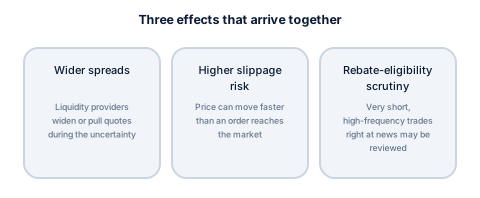
- Spreads commonly widen sharply in the seconds around a scheduled high-impact news release, as liquidity providers reduce depth or pull quotes during the uncertainty.
- Slippage risk rises in the same window, since price can move faster than an order can be matched at the requested level, especially on market orders.
- These two effects stack: a trade opened right at a news release can carry both a wider-than-usual spread and slippage on the fill, on top of each other.
- Some brokers apply extra scrutiny to very short-duration, high-frequency trades opened right around news for rebate-eligibility purposes, similar to how ultra-short scalping is sometimes reviewed.
- None of this makes news trading impossible or against the rules by default — it means the real cost of a news-window trade is usually higher than the same trade placed in calmer conditions, and worth planning for.
Why spreads widen around scheduled news
A spread reflects how confident liquidity providers are in the current price. Right before and during a scheduled high-impact release, that confidence drops sharply — the outcome is unknown, and the price can gap the instant the number is published. Liquidity providers respond by quoting wider, or briefly reducing how much volume they'll fill at any price, which is one of the recurring patterns covered in forex trading sessions and when spreads widen. The widening is usually temporary — spreads typically snap back toward normal within seconds to a few minutes once the initial reaction settles — but a trade opened inside that window pays the wider price.
Why slippage risk rises in the same window
Slippage is the gap between the price you requested and the price your order actually fills at, covered in full in slippage and requotes explained. It spikes in the same news window as spread-widening, for a related reason: price can move multiple pips between the moment an order is sent and the moment it reaches the market, especially on a fast-moving market order. A pending order (limit or stop) doesn't eliminate this risk either — it can still fill at a worse level than requested once triggered, or in some conditions fail to fill at all if the market gaps past it.
The combined cost, illustrated
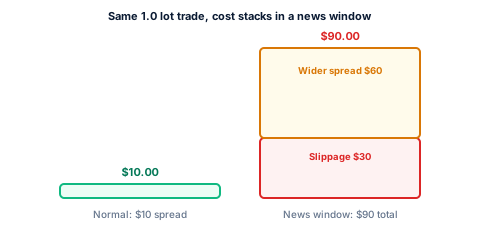
Take an illustrative EUR/USD trade at 1.0 lot, where pip value is a fixed $10:
- Normal conditions: spread ≈ 1.0 pip → spread cost ≈ $10.00, slippage ≈ $0 (illustrative, calm market).
- News window: spread ≈ 6.0 pips (widened) → spread cost ≈ $60.00, plus illustrative slippage of 3.0 pips ≈ $30.00 → combined extra cost ≈ $90.00 on the exact same trade size.
These numbers are rounded, illustrative assumptions used to show the pattern — that the two effects stack rather than substitute for each other — not a prediction of any specific release's actual widening or slippage.
Rebate eligibility and ultra-short news trades
A rebate is paid on qualifying closed trading volume, calculated after a broker pays the underlying advertising (IB referral) fee — see how forex rebates work. Most news trades, held for a normal duration even if that duration is short, qualify the same as any other trade. What some brokers scrutinize is a narrower pattern: an extremely high frequency of very short-duration trades clustered right around scheduled releases, which can resemble the kind of activity covered in forex rebates for scalpers and hedging and rebate eligibility — both of which are ultimately about the same underlying question: does the broker's minimum-holding-time or anti-abuse policy apply to this specific pattern of trades?
This doesn't mean trading news disqualifies you from cashback. A single news trade, or an occasional one, looks nothing like a high-frequency pattern built to generate volume without real market exposure — the distinction brokers are generally drawing is about pattern and frequency, not about news trading as a category.
A practical checklist before trading a scheduled release
- Check the broker's own spread behavior around news — some brokers widen more than others, and this is disclosed in account terms rather than guessed at.
- Size the position for the wider spread and slippage, not the calm-market cost — the illustrative example above shows the real cost can be several times the normal figure.
- Prefer a limit order over a market order if fill-price certainty matters more than fill-certainty — understanding that a limit order can simply not fill in a fast-moving gap.
- Check your minimum holding time, if your broker's terms specify one, before running a very high-frequency approach around scheduled releases.
- Keep records of trades placed around news separately if you want to later isolate their real cost impact — see a trading journal template that tracks costs and rebates.
Frequently asked questions
Not always, but it commonly does, because spreads and slippage both tend to increase in the seconds around a scheduled high-impact release. Whether a specific trade ends up costing more depends on the exact release, the broker's liquidity, and general market conditions at that moment.
Next steps
Review slippage and requotes explained and when spreads widen for the underlying mechanics, then use the cashback calculator to estimate rebates on your typical volume, or register with CB-Dogs before your next trade.
Risk warning: forex and CFD trading carries a high risk of losing money. Cashback does not offset trading losses. Nothing here is investment advice.
Related articles
Cashback on your XM trades — free, paid in USDT
Sign up free