Rollover and Expiry Costs on Index and Commodity CFDs Explained
Some index and commodity CFDs are priced off an underlying futures contract that expires on a schedule; instead of (or alongside) daily swap, the broker rolls the position to the next contract on a set date, applying a price adjustment that can produce its own rollover cost or credit, separate from standard overnight financing.
By CB-Dogs Editorial6 min read
Disclosure: CB-Dogs receives an advertising (referral) fee — sometimes called an IB commission — from brokers for accounts opened or linked through us, and returns part of it to you as cashback, the same model used by cashback and points sites. This does not change your trading costs.
On this page
- The short answer
- Why some CFDs are built on a futures contract at all
- What happens on rollover day
- A worked, illustrative example
- How to check which convention your instrument uses
- How this differs from daily swap and triple swap day
- Does a rebate offset a rollover cost?
- Related reading
- Frequently asked questions
- Work out your own numbers
Forex swap, covered in our swap and overnight fees guide, is charged the same way every night a position stays open. Some index and commodity CFDs work differently: instead of (or in addition to) a nightly swap rate, the instrument tracks an underlying futures contract that expires on a fixed schedule, and the broker has to roll your position to the next contract when that happens. This article covers why that mechanism exists and what it can cost.
Key takeaways
- Some index and commodity CFDs are priced off an underlying futures contract that expires periodically, rather than a synthetic, continuously-priced spot rate.
- When the front-month futures contract nears expiry, the broker rolls open positions to the next contract, which usually involves a price adjustment so the roll itself doesn't create an artificial profit or loss.
- The specific instruments that use futures-based pricing, and whether a rollover produces a separate fee, credit, or is purely a price-adjustment mechanic, vary significantly by broker and by instrument.
- This is a distinct mechanism from daily forex swap and from the triple-swap-day convention, even though all three fall under the general heading of 'overnight' or 'holding' costs.
- A cashback rebate is calculated on qualifying closed lot volume, not on rollover or expiry mechanics, so it doesn't directly offset a rollover cost.
The short answer
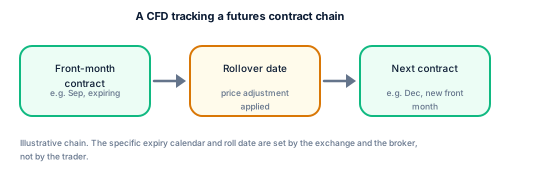
A futures-based CFD tracks the price of a specific underlying futures contract, which itself expires on a set date. As that expiry approaches, the broker moves ("rolls") open client positions from the expiring contract to the next one in the chain, applying a price adjustment intended to keep the roll itself cost-neutral to your position's running profit or loss. Depending on the broker and instrument, this roll can also carry its own separate financing charge or credit, distinct from standard daily swap.
Why some CFDs are built on a futures contract at all
A currency pair has a continuous, always-available spot market to reference, which is why forex CFDs can price continuously and simply charge daily swap for holding a position overnight, as covered in our swap guide. Many index and commodity markets don't work that way at the exchange level — the underlying reference is itself a futures contract with a fixed expiry date (a specific month's crude oil contract, for example, or a quarterly equity index future). A broker offering a CFD on that market has two broad choices: build a synthetic, continuously-priced product and charge something swap-like every night, or track the actual futures contract price directly and handle its periodic expiry with a rollover. Different brokers, and even different instruments at the same broker, can use either approach.
What happens on rollover day
When the front-month contract nears its expiry, the broker's system closes out exposure to it and opens equivalent exposure on the next contract in the chain, at that contract's own price. Because different contract months can trade at meaningfully different prices (reflecting, among other things, expected dividends for an index, or storage and interest-rate costs for a commodity), the broker typically applies a price adjustment to your position so that the switch itself doesn't create an artificial jump in your floating profit or loss purely from moving to a differently-priced contract. Separately from that price adjustment, some brokers also apply an explicit rollover fee or credit reflecting the cost of carrying the position across the gap — this part varies the most by broker and is the detail most worth confirming directly.
A worked, illustrative example
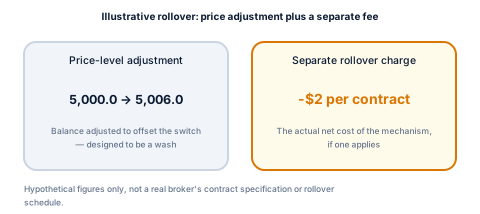
Illustrative inputs: a long index CFD position, front-month contract trading at 5,000.0, next contract trading at 5,006.0 (a 6.0-point difference, reflecting the market's expectation over that period), plus an illustrative rollover charge of $2 per contract.
- Price-level adjustment: the position's reference price moves from 5,000.0 to 5,006.0, and the account balance is adjusted by the equivalent of that 6.0-point difference in the opposite direction, so the position's floating profit or loss is unaffected by the contract switch itself.
- Rollover charge (if applied): a separate −$2 per contract, distinct from the price adjustment above, reflecting the broker's own cost of carrying the position across the roll.
The price adjustment is designed to be a wash; the rollover charge, where one applies, is the actual net cost of the mechanism — similar in spirit to how a forex swap rate is the actual cost of holding a currency position overnight, just calculated on a different schedule tied to the futures calendar rather than every calendar night.
How to check which convention your instrument uses
The only reliable way to know whether a specific index or commodity CFD you trade uses futures-based rollover, nightly swap, or some combination of both is to check that instrument's contract specification or symbol properties directly on your own platform. A few things worth confirming rather than assuming:
- Whether the instrument shows an expiry date at all, or trades as a continuously-priced instrument with ordinary daily swap instead.
- If it does expire, how far in advance the roll happens and whether it's announced to clients beforehand.
- Whether the roll applies a separate fee or credit on top of the price adjustment, and how that's disclosed on your statement — our guide to reading a trade confirmation and account statement covers how to identify an unfamiliar line item like this.
How this differs from daily swap and triple swap day
Daily forex swap, covered in our swap and overnight fees guide, and the triple-swap-day convention, covered in our triple swap day guide, both apply to continuously-priced instruments on a nightly, calendar-based schedule. Futures-based rollover is a different mechanism entirely: it's tied to the underlying futures contract's own expiry calendar, which can be monthly, quarterly, or another interval entirely depending on the specific contract, not a nightly cycle. A single instrument is generally subject to one convention or the other for a given cost component, but it's worth checking your own instrument's specification rather than assuming which applies.
Does a rebate offset a rollover cost?
No, not directly. A cashback rebate is calculated on qualifying closed lot volume, as explained in our guide to how forex rebates work — it has no connection to a futures rollover's price adjustment or any separate rollover fee. The rebate still reduces your combined overall trading cost across whatever categories made it up, but it isn't a direct offset against a specific rollover charge.
Related reading
- Forex swap and overnight fees explained — the nightly-financing mechanism this article's futures-based rollover is an alternative (or complement) to.
- Gold (XAU/USD) trading costs explained — how one specific, widely-traded commodity CFD's cost structure works in practice.
- EUR/USD vs. gold vs. indices trading costs compared — a broader framework for comparing cost structures across instrument types.
Frequently asked questions
The process of moving an open position from an expiring underlying futures contract to the next one in the chain, typically with a price adjustment so the switch doesn't itself create an artificial jump in the position's profit or loss.
Work out your own numbers
Check your own broker's contract specification for the specific index or commodity CFD you trade to see whether it uses futures-based rollover, nightly swap, or both. To see how qualifying volume adds up over time regardless of instrument, try the cashback calculator, or register with CB-Dogs before your next trade.
Risk warning: forex and CFD trading carries a high risk of losing money. Cashback does not offset trading losses. Nothing here is investment advice.
Related articles
Cashback on your XM trades — free, paid in USDT
Sign up free