Exness Account Types Explained: Standard, Pro, Raw Spread and Zero
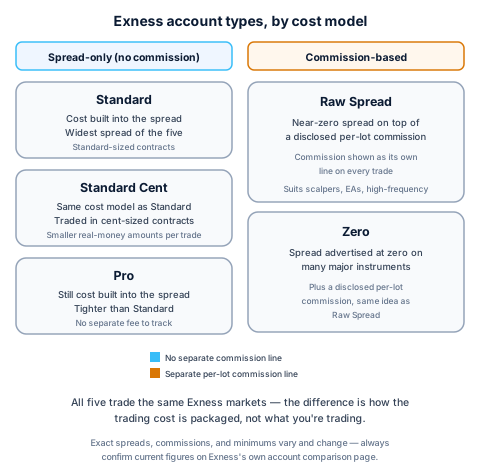
Exness offers five account types that split into two cost models: Standard, Standard Cent, and Pro fold trading cost into the spread with no separate commission, while Raw Spread and Zero pair a much tighter spread with a disclosed per-lot commission — which one is 'best' depends on how you trade, not on a single universal answer.
By CB-Dogs Editorial6 min read
Disclosure: CB-Dogs receives an advertising (referral) fee — sometimes called an IB commission — from brokers for accounts opened or linked through us, and returns part of it to you as cashback, the same model used by cashback and points sites. This does not change your trading costs.
On this page
- Exness's five account types at a glance
- Standard vs. Standard Cent: same cost model, different contract size
- Pro: still spread-only, but tighter
- Raw Spread vs. Zero: two commission-based tiers, not opposites
- How CB-Dogs cashback applies to each account type
- Which Exness account is best?
- Frequently asked questions
- Related reading
Exness offers five account types under one platform, and "which one should I use" comes up constantly — as "exness standard vs pro," "exness raw spread vs zero," and on its own. This guide compares all five side by side: how each packages its trading cost, who it tends to suit, and how CB-Dogs cashback applies differently depending on which one you pick. Deciding between Exness and XM first? See our Exness vs. XM comparison. Already know you want Exness? See how to open an Exness account and link your cashback.
Key takeaways
- Exness's five account types split into two cost models: Standard, Standard Cent, and Pro fold cost into the spread with no separate commission; Raw Spread and Zero add a disclosed per-lot commission on top of a much tighter spread.
- Standard Cent isn't a different cost model from Standard — it's the same spread-only structure, traded in cent-sized contracts so you can use much smaller real-money amounts per position.
- Pro sits between Standard and the commission-based tiers: still no separate commission line, but a tighter spread than Standard.
- Raw Spread and Zero are close cousins rather than opposites — both charge a per-lot commission on top of a near-zero or zero-advertised spread; the practical difference is which instruments each one prices that way.
- CB-Dogs cashback is calculated differently depending on the account type's cost model, because it comes from a share of what Exness actually pays us — see the live rates below rather than assuming one account type automatically pays more.
Exness's five account types at a glance
| Account type | Cost model | Commission | Spread character | Typically suits |
|---|---|---|---|---|
| Standard | Spread-only | None | Widest of the five | Beginners who want one simple, all-in cost |
| Standard Cent | Spread-only (same as Standard) | None | Same as Standard | Beginners trading very small real-money amounts |
| Pro | Spread-only | None | Tighter than Standard | Traders who want a lower cost without tracking a commission line |
| Raw Spread | Commission-based | Per lot, disclosed | Near-zero | Scalpers, EA/algo traders wanting a transparent, itemized cost |
| Zero | Commission-based | Per lot, disclosed | Advertised at zero on many majors | High-frequency and EA traders prioritizing the tightest possible spread |
Standard vs. Standard Cent: same cost model, different contract size
"Exness standard vs pro" is the comparison most people search for, but Standard vs. Standard Cent is worth separating out first, because it's a different kind of difference. Standard and Standard Cent use the same cost model — no separate commission, cost folded into the spread — and, as far as our research could confirm, the same spread pricing. What changes is the contract size: Standard Cent trades in cent-denominated lots, so a given lot count corresponds to a much smaller real-money position than the same lot count on Standard.
That makes Standard Cent less a "cheaper" account and more a smaller-stakes version of the same account, suiting traders who want to practice position sizing or trade real money without a standard-sized amount at risk per trade — a different goal from Raw Spread or Zero below, which exist to minimize cost per lot at a size you're already committed to.
Pro: still spread-only, but tighter
Pro sits in an interesting middle position. Like Standard, it charges no separate commission — the cost is entirely in the spread — but that spread is described as noticeably tighter, positioning Pro as a step up in cost efficiency without adding a commission line to track on every trade.
That makes Pro a fit for traders who've outgrown Standard's spread but don't want the bookkeeping of a disclosed commission — still one number (the spread) to reason about, just a smaller one. It's a different trade-off from Raw Spread or Zero, which accept the extra line item for an even tighter headline spread; our guide to raw spread vs. standard accounts covers the break-even math behind that trade-off using XM's version of the same structural choice.
Raw Spread vs. Zero: two commission-based tiers, not opposites
"Exness raw spread vs zero" implies these two are meaningfully different, but structurally they're close cousins: both charge a disclosed commission per lot, paired with a spread far tighter than the spread-only tiers above. Zero is generally described as advertising a spread of literally zero on a set of its most-traded major instruments; Raw Spread is generally described as a near-zero, raw interbank-style spread across a broader instrument set rather than a flat zero on a specific list.
In practice, the decision tends to come down to which specific instruments you trade most, not one being categorically cheaper — a zero-spread guarantee only matters on the instruments it covers, and outside that list the two behave similarly. Both exist for the same reason: traders (often scalpers or EAs) who want the tightest, most predictable spread and are willing to see commission itemized separately for it.
How CB-Dogs cashback applies to each account type
This is where the account type you choose stops being only a trading-cost question and starts affecting your cashback too, because Exness doesn't pay us the same way across all five types:
- Standard and Pro pay us a percentage share of the spread revenue Exness earns on your trading, rather than a fixed dollar amount. Our displayed figures for these two are estimates at our current partner rank — your actual cashback is always calculated from the commission Exness actually reports, not the estimate shown.
- Raw Spread and Zero pay us a per-lot commission tied to the disclosed fee structure, also shown as an estimate for the same reason: it varies by instrument and by our partner level over time.
- Standard Cent isn't broken out as its own row below, since it shares Standard's revenue-share model rather than a distinct commission structure — cashback on it is credited the same way as Standard, scaled to the smaller real trade sizes it uses.
None of this is a fixed rate you can bank on in advance — see per-lot vs. percentage cashback for why a revenue-share account and a fixed per-lot account produce different numbers, without one being more generous than the other.
| Account type | Rebate / lot (USDT) |
|---|---|
| StandardNo separate commission — Exness pays partners a share of the spread. The estimate below is for EURUSD at our current partner rank; GBPUSD and gold (XAUUSD) typically pay more per lot, tighter-spread pairs less. Rates rise automatically as our trading volume with Exness grows. | 0.96 |
| ProNo separate commission — Exness pays partners a share of the spread, at a lower percentage than Standard. We don't yet have a reliable per-instrument estimate for this account type, so no figure is shown; your cashback is still 60% of the actual commission Exness pays us. | 0.0 |
| ZeroCommission-based account with near-zero raw spreads. The estimate below is for EURUSD at our current partner rank; other instruments vary. Cashback is paid in addition to the raw spread and does not affect the commission you pay Exness. | 0.25 |
| Raw SpreadCommission-based account with raw interbank spreads. Exness pays partners a fixed amount per lot that varies by instrument; we don't yet have a reliable figure to show, so no estimate is listed — your cashback is still 60% of the actual commission Exness pays us. | 0.0 |
Provisional rate
Which Exness account is best?
There isn't one universal answer — "best" depends on what you're optimizing for:
- New or cautious: Standard — one cost (the spread), nothing else to track.
- Want to trade very small real-money amounts while learning: Standard Cent, same model, sized down.
- Comfortable with Standard, want lower cost without a commission line: Pro.
- Scalping, running an EA, or trading frequently enough that a tight, itemized spread outweighs a commission: Raw Spread or Zero, chosen by which instruments you trade most.
- Optimizing net cost, not just gross cost: run the numbers with cashback included using the cashback calculator — the lowest gross cost isn't always the lowest cost after cashback; see comparing broker cost with rebates included.
Frequently asked questions
Five: Standard, Standard Cent, Pro, Raw Spread, and Zero. Standard, Standard Cent, and Pro charge no separate commission; Raw Spread and Zero charge a disclosed per-lot commission on top of a much tighter spread.
Related reading
- Exness vs. XM: which is better? — account types and cashback mechanics across both brokers.
- How to open an Exness account and link it to your cashback — start here once you've picked a type.
- Exness withdrawal: methods, times, and fees — once you're ready to take money out.
- Raw spread vs. standard account: which is cheaper? — the break-even math behind the trade-off.
- Per-lot vs. percentage cashback — why the two cost models produce different cashback figures.
- Forex cent accounts explained — the mechanics behind Standard Cent-style accounts.
- Exness broker page — live cashback rates and hold-period details.
Ready to compare with your own numbers? Register with CB-Dogs, then open your Exness account with whichever account type fits how you trade.
Risk warning: forex and CFD trading carries a high risk of losing money. Cashback does not offset trading losses. Nothing here is investment advice.
Related articles
Cashback on your XM trades — free, paid in USDT
Sign up free