Holiday and Year-End Forex Spreads: Why Costs Spike When Liquidity Dries Up
Forex spreads commonly widen around Christmas, New Year, and other major market holidays because fewer liquidity providers are actively quoting prices, and thinner liquidity means a wider gap between the best available buy and sell price — the same underlying mechanism as ordinary session-transition widening, just concentrated into a predictable annual window.
By CB-Dogs Editorial6 min read
Disclosure: CB-Dogs receives an advertising (referral) fee — sometimes called an IB commission — from brokers for accounts opened or linked through us, and returns part of it to you as cashback, the same model used by cashback and points sites. This does not change your trading costs.
On this page
- The short answer
- Why liquidity dries up around specific dates
- Which periods commonly see the widest spreads
- Worked example (illustrative numbers)
- What to check before trading a thin-liquidity period
- Does a rebate apply during holiday periods?
- Related reading
- Frequently asked questions
- Work out your own numbers
Our trading sessions guide covers the recurring, everyday pattern of session-transition and low-liquidity spread widening, and mentions holidays only briefly, in its closing risk disclosure. It doesn't walk through the specific, predictable annual window around Christmas, New Year, and other major market holidays, when the same underlying mechanism shows up in a more concentrated and often more severe form. This article covers that window specifically: why it happens, which periods commonly see it, and what it means for your trading cost.
Key takeaways
- Spreads commonly widen around major market holidays (Christmas, New Year, and other bank holidays affecting the major financial centers) because fewer liquidity providers are actively quoting prices, and thinner liquidity means a wider typical gap between the best buy and sell price.
- This is the same underlying mechanism as ordinary session-transition spread widening, covered generally in our trading sessions guide — the holiday period simply concentrates it into a longer, more predictable, and often more severe window.
- The week between Christmas and New Year's Day is commonly cited as the thinnest-liquidity stretch of the entire calendar year for forex, since major financial centers in multiple time zones are closed or reduced at the same time.
- Thin holiday liquidity is associated not just with wider spreads but with a higher chance of slippage on market orders and gaps around scheduled news that still occurs during a nominally quiet period.
- A cashback rebate is calculated on qualifying closed lot volume regardless of the time of year or how wide the spread was at the time of the trade — it doesn't adjust for holiday conditions in either direction.
The short answer
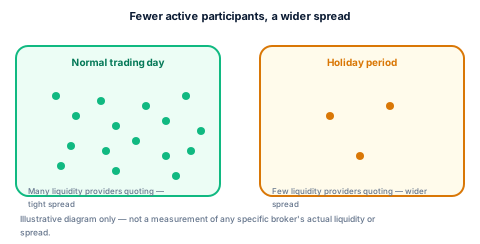
A forex spread is the gap between the best available buy price and best available sell price a broker can source from its liquidity providers at any given moment, covered in general in our lot, pip, and spread cost guide. That gap widens whenever fewer market participants are actively quoting prices, because there's less competition pushing the buy and sell prices closer together. Around major market holidays, many banks, institutional desks, and liquidity providers across one or more major financial centers are closed or operating with reduced staff at the same time — so the everyday session-transition widening covered in our trading sessions guide shows up in a longer, more concentrated, and often more pronounced form.
Why liquidity dries up around specific dates
The interbank forex market doesn't have a single central exchange or a single closing bell — it's a network of banks, institutional desks, and other liquidity providers spread across multiple time zones, continuously quoting prices to each other and to brokers. On an ordinary trading day, enough of that network is active at any given time to keep spreads relatively tight. Around a major holiday, a meaningful share of that network goes offline at once — not just one region's local holiday, but often overlapping closures across several major financial centers within the same calendar window. With fewer participants actively quoting, the best available buy and sell prices a broker can source tend to sit further apart, which is exactly what a wider spread reflects.
Which periods commonly see the widest spreads
The stretch between Christmas Eve and New Year's Day is widely cited as the thinnest-liquidity period of the entire calendar year for forex, since it overlaps a public holiday in most major financial centers at roughly the same time, and many institutional desks that remain technically open still run with reduced staff and reduced risk appetite through the whole week. Thanksgiving in the United States (and the shortened trading day that commonly follows it) is a smaller-scale version of the same effect, concentrated around US-session liquidity specifically. Other national bank holidays in major financial centers (the UK, the eurozone, Japan, and others) can produce a similar, if more localized, thinning — a UK bank holiday, for example, is more likely to affect GBP-crossing pairs specifically than a pair with no GBP leg. Month-end and quarter-end periods can add a separate, unrelated layer of unusual volume (from institutional rebalancing) on top of any holiday effect, which is worth distinguishing from pure holiday thinness even though both can widen spreads around the same calendar dates.
Worked example (illustrative numbers)
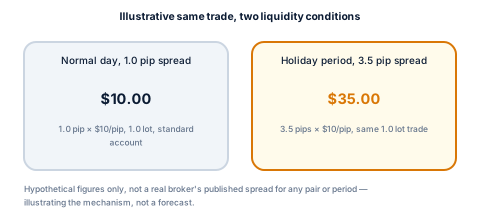
Take an illustrative major pair with a typical spread of 1.0 pip on a standard account, at a fixed pip value of $10 per lot. A same-day 1.0 lot trade under normal conditions costs $10.00 in spread. If that same pair's spread widens to an illustrative 3.5 pips during the Christmas-to-New-Year window — a multiple sometimes observed during genuinely thin periods, though the exact figure varies enormously by broker, pair, and specific date — the identical 1.0 lot trade's spread cost rises to $35.00, a $25.00 difference from the exact same nominal trade, without the trader having done anything differently.
All figures above are rounded, hypothetical inputs used to illustrate the mechanism — not a real broker's published holiday spread for any pair, and not a prediction of how much any specific instrument will widen during any specific future holiday period.
What to check before trading a thin-liquidity period
A few practical checks help before trading through a known holiday window: confirm your broker's published holiday trading-hours schedule (some instruments close early, open late, or don't trade at all on certain dates), check whether your account's typical spreads have already widened compared to a normal week, consider reducing position size to account for a higher chance of slippage on market orders (covered in our slippage and requotes guide), and be aware that a holiday period bordering a weekend compounds ordinary weekend gap risk with extra closed time during which news can still occur. If your account uses a variable-spread pricing model, expect the widening to show up directly in the quoted spread itself; a fixed-spread account may instead show it through other mechanisms like requotes or execution delays, depending on the broker's specific terms.
Does a rebate apply during holiday periods?
Yes — a cashback rebate is calculated on qualifying closed lot volume the same way regardless of the time of year, covered in our guide to how forex rebates work. It doesn't increase to compensate for a wider holiday spread, and it doesn't decrease because trading conditions were thinner than usual; it's a flat, volume-based calculation that runs independently of current spread conditions in either direction.
Related reading
- Forex trading sessions: when spreads widen — the everyday, recurring version of the same liquidity mechanism this article covers in its concentrated holiday form.
- Weekend gaps in forex: risk and cost explained — a related closed-market risk that compounds when a holiday falls adjacent to a weekend.
- Slippage and requotes explained — why thin liquidity raises the chance of a market order filling at a worse price than expected.
Frequently asked questions
Fewer banks, institutional desks, and liquidity providers are actively quoting prices when major financial centers are closed for a holiday. With less competition narrowing the gap between the best buy and sell price, that gap — the spread — commonly widens.
Work out your own numbers
Check your own broker's published holiday trading-hours schedule and current spreads before trading through any known thin-liquidity period, and compare them against a normal trading week's figures using the formula in our lot, pip, and spread cost guide. To see how qualifying volume adds up over a full year regardless of season, try the cashback calculator, or register with CB-Dogs to start earning cashback on the volume you already trade.
Risk warning: forex and CFD trading carries a high risk of losing money. Cashback does not offset trading losses. Nothing here is investment advice.
Related articles
Cashback on your XM trades — free, paid in USDT
Sign up free