Forex Spread Cost Per Trade: A Formula-Driven Table for Common Pairs
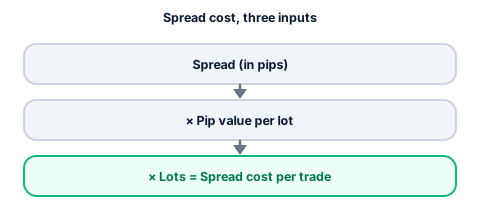
Spread cost per trade equals the spread in pips multiplied by the pip value per lot multiplied by lot size; the table here applies that formula to illustrative spreads on common pairs so you can see the pattern before plugging in your own broker's live spread.
By CB-Dogs Editorial4 min read
Disclosure: CB-Dogs receives an advertising (referral) fee — sometimes called an IB commission — from brokers for accounts opened or linked through us, and returns part of it to you as cashback, the same model used by cashback and points sites. This does not change your trading costs.
On this page
"What does the spread actually cost me?" has a different answer for every pair, because pip value itself isn't the same across pairs. Rather than repeating the formula once and leaving you to redo the arithmetic six times, this guide builds a single reference table — spread cost per trade, per pair, per lot size — directly from the formula, so you can see the pattern at a glance before swapping in your own broker's live numbers.
Key takeaways
- Spread cost per trade equals the spread in pips × the pip value per lot × the number of lots — the same formula for every pair, but pip value itself differs by pair.
- USD-quoted pairs (EUR/USD, GBP/USD, AUD/USD, NZD/USD) have a fixed pip value of $10 per standard lot, so their spread cost scales with spread alone.
- USD/JPY, USD/CAD and similar pairs have a pip value that shifts with the exchange rate, so their spread cost per trade is only approximate unless recalculated against the live rate.
- Every spread figure in this article's table is an illustrative, rounded assumption — not a live quote from any broker — used only to demonstrate how the formula behaves across pairs.
- A rebate is credited on qualifying lot volume after the trade closes and reduces net cost, but it doesn't change the spread cost shown in the table itself.
The formula behind every cell in this table
Spread cost per trade = Spread (in pips) × Pip value per lot × Lots.
The full derivation of pip value, with worked examples, is covered in forex lot size, pips, and spread cost explained; the quick-reference pip value figures used below come from the same method as pip value for major pairs and gold. This article's contribution is putting several pairs' numbers side by side in one table so the pattern — not just one pair's arithmetic — is visible.
Illustrative pip values used in this table
Pip value depends on whether the pair is quoted in USD or not:
- USD-quoted pairs (EUR/USD, GBP/USD, AUD/USD, NZD/USD) have a fixed pip value of $10.00 per standard (1.0) lot, because the pip's cash value is already denominated in USD regardless of the exchange rate.
- Pairs where USD is the base, not the quote (USD/JPY, USD/CAD) have a pip value that shifts with the exchange rate, since the pip's raw value is in the quote currency (JPY, CAD) and has to be converted back to USD. The figures below assume an illustrative USD/JPY rate near 150.00 and an illustrative USD/CAD rate near 1.35 — recalculate at the current rate for an accurate number.
- Gold (XAU/USD) uses a different quoting convention (cents/points rather than pips) and is covered separately in gold (XAU/USD) trading costs explained and pip value for gold, silver and oil rather than forced into this table.
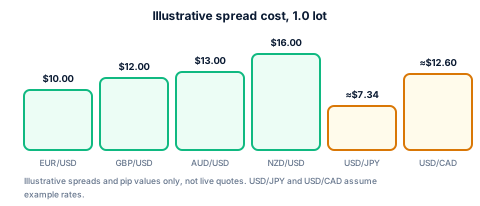
Spread cost per trade table (illustrative)
| Pair | Illustrative spread | Pip value (1.0 lot) | Spread cost (1.0 lot) | Spread cost (0.1 lot) |
|---|---|---|---|---|
| EUR/USD | 1.0 pip | $10.00 (fixed) | $10.00 | $1.00 |
| GBP/USD | 1.2 pips | $10.00 (fixed) | $12.00 | $1.20 |
| AUD/USD | 1.3 pips | $10.00 (fixed) | $13.00 | $1.30 |
| NZD/USD | 1.6 pips | $10.00 (fixed) | $16.00 | $1.60 |
| USD/JPY | 1.1 pips | ≈$6.67 (at ~150.00) | ≈$7.34 | ≈$0.73 |
| USD/CAD | 1.7 pips | ≈$7.41 (at ~1.35) | ≈$12.60 | ≈$1.26 |
All spread and cost figures are rounded, illustrative assumptions, not live quotes from any broker.
Recalculating for your own lot size
Every column above scales linearly with lots, so you don't need a new formula for a different position size — just multiply:
- 0.01 lot (micro): divide the 1.0-lot figure by 100.
- 0.1 lot (mini): divide by 10 (shown as its own column above).
- 5.0 lots: multiply the 1.0-lot figure by 5.
This is the same linear relationship covered for cent-denominated accounts in forex cent accounts explained — the formula doesn't change, only the lot-size input does.
Why your real spread may differ from this table
The table exists to show the pattern — how cost scales with spread and pip value — not to predict your exact next trade's cost. Several things move the real number:
- Variable vs. fixed spreads. Most retail accounts run on a variable spread that widens and narrows with market conditions, especially around news and low-liquidity windows — see when spreads widen.
- Account type. A raw-spread account typically shows a much tighter spread than the illustrative figures above, offset by a separate commission — see raw spread vs. standard accounts.
- Exchange-rate drift. For any pair where pip value isn't fixed in USD (USD/JPY, USD/CAD above), the pip value itself changes as the rate moves, which changes the cost even if the spread in pips stays the same.
Turning gross spread cost into net cost with a rebate
A cashback rebate is calculated on qualifying closed lot volume and credited afterward, in USDT — it doesn't change the spread you see on any single trade. See how forex rebates work for the full mechanics, and check the live, current rate for your account type here rather than any number typed above:
| Account type | Rebate / lot (USDT) |
|---|---|
| StandardSpread-based account, no commission. | 9.0 |
| MicroRebate is calculated per 100,000 units of micro-lot volume (i.e. the same per-lot rate as Standard, scaled to micro-lot size). | 9.0 |
| Ultra LowLower spreads, spread-based account, no commission. | 3.0 |
| KiwamiXM's tightened-spread account tier available in select regions. | 6.0 |
| ZeroCommission-based account. Rebate is paid in addition to the raw spread — commission you pay is unaffected. | 4.5 |
Provisional rate
Frequently asked questions
Because EUR/USD is quoted in USD — the pip's cash value is already in dollars. USD/JPY is quoted in JPY, so its pip value is calculated in yen first, then converted back to USD at the current exchange rate, which is why it shifts as the rate moves.
Next steps
Check your account's live spread directly with your broker rather than assuming the illustrative figures above, use the cashback calculator to estimate what a rebate would return on your real volume, or register with CB-Dogs before your next trade so it counts toward qualifying volume.
Risk warning: forex and CFD trading carries a high risk of losing money. Cashback does not offset trading losses. Nothing here is investment advice.
Related articles
Cashback on your XM trades — free, paid in USDT
Sign up free