How to Budget Your Forex Trading Costs as a Percentage of Account Size
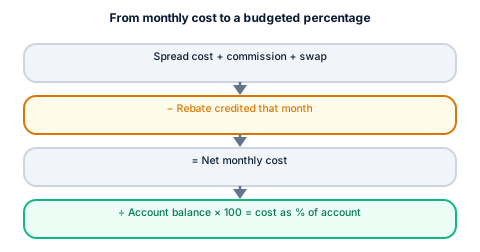
Dividing monthly trading cost (spread plus commission plus swap, minus any rebate) by account balance turns cost into a percentage you can budget against and track over time, more comparable than a raw dollar figure alone.
By CB-Dogs Editorial3 min read
Disclosure: CB-Dogs receives an advertising (referral) fee — sometimes called an IB commission — from brokers for accounts opened or linked through us, and returns part of it to you as cashback, the same model used by cashback and points sites. This does not change your trading costs.
On this page
A raw dollar figure for monthly trading costs doesn't tell you much on its own — $150 in costs means something very different on a $2,000 account than on a $50,000 one. Turning that dollar figure into a percentage of your account size gives you a number you can actually set a personal budget against, and track consistently even as your account balance changes. This guide walks through the formula and how to use it.
Key takeaways
- Cost as a percentage of account size is calculated as (monthly spread cost + commission + swap − rebate) ÷ account balance, expressed as a percentage.
- The same dollar cost represents a bigger percentage drag on a smaller account, which is why a percentage figure is more comparable across time and across different account sizes than a raw dollar total.
- There's no universal 'correct' percentage — it depends on your trading frequency, strategy, and how you weigh cost against your own expected returns, which this article does not predict.
- Rebates reduce the percentage the same way they reduce the dollar figure — track net cost (after rebate), not gross cost, for the number that actually reflects your real trading drag.
- Reviewing this percentage monthly, alongside your actual account balance, catches cost creep (from a bigger account) or rising relative drag (from a shrinking one) that a dollar figure alone can hide.
The formula
Monthly cost as a percentage of account size is:
(Spread cost + Commission + Swap − Rebate) ÷ Account balance × 100
Each component in the numerator is covered in full elsewhere on this site — spread and commission in lot, pip, and spread cost explained, swap in forex swap and overnight fees explained, and the rebate figure from your cashback statement or the cashback calculator. What this article adds is the final step: dividing that net cost by your account balance to get a single comparable percentage.
Why the percentage matters more than the dollar figure
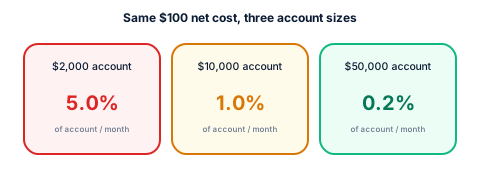
An identical hypothetical $100 monthly net cost is a 5% monthly drag on a $2,000 account, a 1% drag on a $10,000 account, and a 0.2% drag on a $50,000 account — the dollar figure alone hides how differently that cost actually weighs on each account. Tracking the percentage instead lets you set one personal threshold and check against it consistently, regardless of how your balance changes over time (from deposits, withdrawals, or trading results).
Setting your own budget threshold
There's no single "correct" percentage that applies to every trader — it depends heavily on your trading frequency, typical position size relative to your account, and what return you're aiming to earn net of costs. A high-frequency strategy naturally runs a higher cost percentage than a low-frequency one, and that isn't automatically a problem if the strategy's expected return accounts for it. What matters is picking a number that's meaningful for your own approach and then tracking it consistently, the same way how cashback lowers your break-even win rate covers a related but distinct cost-to-performance calculation.
Where the rebate fits in
Subtracting your rebate before dividing by account balance is the step that turns a gross-cost percentage into a genuinely useful net-cost percentage. A trader who tracks only gross cost as a percentage of account size is measuring a number that's structurally higher than what they're actually losing to costs, once cashback is factored in. See how to verify your rebate volume from trade history to make sure the rebate figure you're subtracting matches what you actually earned that month, not an estimate.
A simple monthly tracking routine
- Pull your closed-trade statement for the month and total the spread cost, commission, and swap (most MT4/MT5-style reports show commission and swap per trade directly; spread cost may need to be estimated from entry/exit pricing if not shown separately).
- Note your actual cashback credited for the same period.
- Subtract the rebate from the gross cost total to get net cost.
- Divide net cost by your account balance at the start of the month (using start-of-month balance, consistently, avoids the percentage being distorted by mid-month deposits or withdrawals).
- Record the resulting percentage alongside the month's raw numbers — a simple spreadsheet row per month is enough to spot a trend over time. See how to keep records of forex rebates for taxes for a compatible record-keeping structure that already tracks most of these inputs.
Frequently asked questions
There isn't a universal normal figure — it depends heavily on trading frequency and strategy. A low-frequency swing trader and a high-frequency scalper will naturally show very different percentages without either one being inherently wrong.
Next steps
See real monthly forex trading cost and how to calculate forex position size from risk for the related cost and risk-sizing formulas, and the cashback calculator to estimate the rebate side of your own net-cost percentage. Register with CB-Dogs so your qualifying volume starts earning cashback that lowers this percentage from your very first trade.
Risk warning: forex and CFD trading carries a high risk of losing money. Cashback does not offset trading losses. Nothing here is investment advice.
Related articles
Cashback on your XM trades — free, paid in USDT
Sign up free