NAS100 (Nasdaq 100) Index CFD Trading Costs Explained (Spread, Point Value, Financing)
A NAS100 (Nasdaq 100) index CFD charges spread quoted in index points, commission on some account types, and an overnight financing charge for positions held past the daily cutoff — the same three cost 'buckets' as any index CFD, but commonly with a higher point value and generally higher realized volatility than a broader index like US30, reflecting its tech-heavy composition.
By CB-Dogs Editorial6 min read
Disclosure: CB-Dogs receives an advertising (referral) fee — sometimes called an IB commission — from brokers for accounts opened or linked through us, and returns part of it to you as cashback, the same model used by cashback and points sites. This does not change your trading costs.
On this page
- The short answer
- Component 1: the spread, and why it commonly runs wider than US30's
- Component 2: commission
- Component 3: overnight financing, or a periodic rollover instead
- Worked example (illustrative numbers, financing-style model)
- When NAS100's cost tends to move the most
- Does a rebate apply to NAS100 trades?
- Related reading
- Frequently asked questions
- Work out your own numbers
Our US30 (Dow) index CFD cost guide covers one major US index CFD's spread, point value, and financing mechanic end to end — but NAS100, the CFD tracking the Nasdaq 100, has its own point-value convention and its own volatility profile that a US30-focused guide doesn't cover. This article gives NAS100 the same dedicated treatment: how its cost components work, why it's commonly associated with higher volatility than a broader index, and a worked example.
Key takeaways
- A NAS100 index CFD tracks the Nasdaq 100 index and charges spread in index points, with each point's dollar value set individually by the broker — the same broker-defined convention covered in our US30 cost guide, applied to a different underlying index.
- Because it's concentrated in large technology and growth companies rather than a broader industrial mix, NAS100 is commonly associated with higher realized price volatility than a broader index like US30, which can also translate into wider typical spreads in absolute point terms.
- The overnight-holding cost on NAS100 is typically an interest-rate-benchmarked financing charge on the position's notional value, similar in concept to US30's, though the specific rate and point value are set independently per instrument by each broker.
- NAS100 is commonly associated with sharp spread widening and price volatility around major technology-sector earnings releases and US Federal Reserve decisions, on top of the general US equity market catalysts that also move US30.
- A cashback rebate on NAS100 works the same way as on any other instrument: calculated on qualifying closed lot volume, not on spread, commission, or overnight financing paid — where it's offered depends entirely on your broker's own qualifying-instrument list.
The short answer
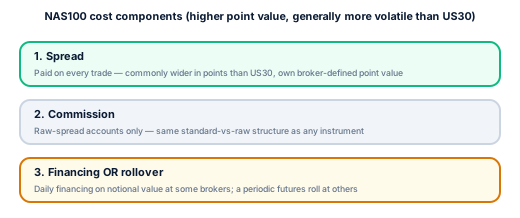
A NAS100 index CFD's trading cost is built the same way as any index CFD — spread in index points, commission on some account types, and an overnight financing charge (or, on some brokers, a periodic futures-style rollover) — following the same structure our US30 cost guide works through in detail. What changes between the two indices is the specific point value (set independently per instrument by each broker) and the typical volatility profile: NAS100 tracks 100 large non-financial companies heavily weighted toward technology and growth sectors, which is commonly associated with sharper price swings than a broader, more diversified index like US30.
Total NAS100 cost ≈ (Spread in points × Point value × Lots) + (Commission per lot × Lots) + (Overnight financing — or periodic rollover, depending on your broker)
Component 1: the spread, and why it commonly runs wider than US30's
Like US30, a NAS100 CFD moves in index points with a dollar value per point set individually by each broker rather than standardized industry-wide, covered generally in our contract size and margin guide. Two factors commonly push NAS100's absolute point spread and typical price movement wider than a broader index like US30: the Nasdaq 100's own price level is often different from the Dow's (which on its own affects nominal point counts without changing percentage terms), and its concentration in technology and growth companies is commonly associated with higher realized volatility than a broader, more diversified index. Neither of these is a claim about which index is "more expensive" in percentage terms — that depends on the actual point value and spread your specific broker quotes for each.
Component 2: commission
Whether NAS100 carries a separate commission depends on account type, the same as any instrument. A standard account commonly folds cost into a wider spread, while a raw-spread or ECN-style account shows a tighter spread plus a disclosed per-lot commission, following the round-turn-vs-per-side conventions in our commission guide. Check your own broker's fee schedule for NAS100's specific commission figure rather than assuming it matches US30's or a forex pair's.
Component 3: overnight financing, or a periodic rollover instead
As with US30, NAS100's overnight-holding cost is commonly an interest-rate-benchmarked financing charge applied to the position's full notional value, or, on some brokers, a periodic rollover tied to an underlying Nasdaq 100 futures contract instead of a daily charge — the mechanic covered in full in our rollover and expiry costs on index and commodity CFDs guide. The two US indices commonly follow the same broker's chosen pricing model (both financing-style or both futures-roll-style), but the specific rate isn't necessarily identical between them, since each instrument's financing rate is set independently.
Worked example (illustrative numbers, financing-style model)
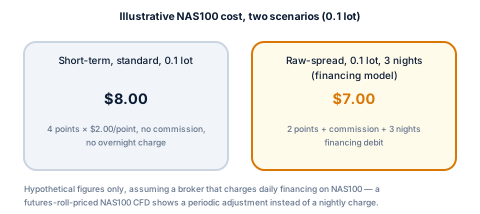
Example 1 — a short-term trade, standard account, 0.1 lot. Illustrative spread: 4 points, at an illustrative point value of $2.00 at 0.1 lot (a different point-value convention from US30's $1.00, set independently by the broker). Spread cost: 4 × $2.00 = $8.00, no separate commission, no overnight charge since the position closes the same session.
Example 2 — a raw-spread account, same 0.1 lot, held 3 nights, financing-style pricing. Illustrative spread: 2 points × $2.00 = $4.00. Illustrative commission: $3.00 per lot round turn × 0.1 lot = $0.30. Illustrative financing: −$0.90 per night × 3 nights = −$2.70 (a debit in this example). Total: $4.00 + $0.30 + $2.70 = $7.00.
All figures above are rounded, hypothetical inputs used to demonstrate the formula — not a real broker's spread, point value, commission, or financing rate for NAS100, and not a CB-Dogs cashback rate. A futures-roll-priced NAS100 CFD held over the same period wouldn't show a nightly charge at all — instead, a one-time price-level adjustment only if a roll date fell within the holding period, following the worked example in our rollover and expiry costs guide.
When NAS100's cost tends to move the most
NAS100 is commonly associated with sharp spread widening and price volatility around major technology-sector earnings releases (particularly from large index-weighted companies), US Federal Reserve interest-rate decisions (given the sector's historical sensitivity to changes in long-term interest-rate expectations), and scheduled high-impact US economic data, layered on top of the general US equity market catalysts that also move US30. As with US30, a CFD broker's NAS100 trading hours commonly extend well beyond the underlying market's regular session, and liquidity — and typical spread — can differ between the regular cash-session hours and any extended-hours window, following the general session-liquidity pattern in our trading sessions guide.
Does a rebate apply to NAS100 trades?
Cashback eligibility depends on your broker's own list of qualifying instruments, which commonly includes major index CFDs like NAS100 alongside US30, forex pairs, gold, silver, and oil — check your specific broker's terms via our guide to how forex rebates work. As with any instrument, the rebate is calculated on qualifying closed lot volume, not on the spread, commission, or overnight financing you paid, so it functions as a partial offset against your combined NAS100 trading cost rather than a direct reduction of any one component.
Related reading
- US30 (Dow) index CFD trading costs explained — the same cost-component breakdown applied to a broader, generally less volatile US index.
- EUR/USD vs. gold vs. indices: comparing trading costs — the generic cross-instrument comparison framework this article's index-specific figures build on.
- Rollover and expiry costs on index and commodity CFDs — the full mechanics of the futures-roll model some index CFDs use instead of daily financing.
Frequently asked questions
Not necessarily. Each broker sets point value individually per instrument, so a NAS100 point and a US30 point at the same broker can have different dollar values. Check your own platform's contract specification for each index separately.
Work out your own numbers
Check your own platform's current NAS100 contract specification — spread, point value, commission structure, and whether it uses daily financing or a futures-style rollover for overnight positions — and plug it into the appropriate formula above for an accurate total. To see how qualifying volume adds up over time, try the cashback calculator, or register with CB-Dogs before your next trade.
Risk warning: forex and CFD trading carries a high risk of losing money. Cashback does not offset trading losses. Nothing here is investment advice.
Related articles
Cashback on your XM trades — free, paid in USDT
Sign up free