NZD/USD Trading Costs Explained (Spread, Swap, Pip Value)
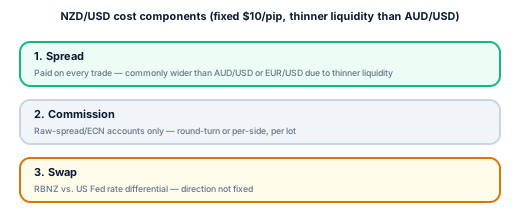
NZD/USD trading cost is built from the same three components as any forex pair — spread, commission on raw-spread accounts, and swap for positions held overnight — with a fixed USD pip value like other USD-quoted majors, but it's commonly one of the thinner-liquidity majors, which tends to show up as a wider typical spread than EUR/USD or AUD/USD.
By CB-Dogs Editorial6 min read
Disclosure: CB-Dogs receives an advertising (referral) fee — sometimes called an IB commission — from brokers for accounts opened or linked through us, and returns part of it to you as cashback, the same model used by cashback and points sites. This does not change your trading costs.
On this page
Our forex spread cost per trade table includes NZD/USD as one row among several common pairs, alongside its more heavily traded counterpart AUD/USD — but a single table row doesn't explain why the two "Antipodean" pairs commonly carry different typical spreads. This article gives NZD/USD its own full cost breakdown: its fixed USD pip value, why it's generally considered one of the thinner-liquidity major pairs, and a worked example combining spread, commission, and swap.
Key takeaways
- NZD/USD quotes the US dollar as the quote currency, so its pip value comes out fixed at $10 per pip per standard lot on a USD account — the same convention as EUR/USD, GBP/USD, and AUD/USD.
- NZD/USD is commonly grouped with AUD/USD as an 'Antipodean' commodity-currency pair, but New Zealand's smaller, more agriculture-and-dairy-export-driven economy gives it its own distinct liquidity and volatility profile, generally thinner than AUD/USD's.
- Thinner typical liquidity commonly means a wider typical spread than AUD/USD or EUR/USD, and can mean more noticeable spread widening outside New Zealand and Australian trading hours.
- Swap on NZD/USD reflects the interest-rate differential between the Reserve Bank of New Zealand and the US Federal Reserve, and — like any pair — its direction isn't fixed and changes as rate policy changes.
- A cashback rebate on NZD/USD works the same way as on any other pair: calculated on qualifying closed lot volume, not on spread, swap, or how thin the pair's liquidity happens to be.
The short answer
NZD/USD's trading cost is made up of the same three components as any forex pair — spread, commission (on raw-spread accounts), and swap for positions held overnight — using the standard formula from our lot, pip, and spread cost guide. Its pip value follows the same fixed-USD convention as our AUD/USD cost guide already covers, since USD is the quote currency in both pairs. What differs is liquidity: NZD/USD is generally considered one of the thinner-traded major pairs, which commonly shows up as a wider typical spread and, at times, sharper moves on comparatively thin volume.
Total NZD/USD cost ≈ (Spread in pips × $10 per pip × Lots) + (Commission per lot × Lots) + (Swap rate × $10 per pip × Lots × Nights held)
Component 1: the spread, and why NZD/USD tends to run wider
Because USD is the quote currency, NZD/USD's pip value follows the standard fixed convention: 0.0001 × 100,000 units per standard lot = $10 per pip, the same figure used for EUR/USD, GBP/USD, and AUD/USD, covered generally in our pip value reference guide. Where NZD/USD differs is on the liquidity side rather than the arithmetic side: it's generally considered one of the less heavily traded major pairs, reflecting New Zealand's comparatively small economy relative to the other major-pair currencies. Thinner typical liquidity is commonly associated with a wider typical spread than a more heavily traded pair like EUR/USD or even AUD/USD, and can mean the spread widens more noticeably outside the New Zealand and Australian trading hours when the pair's natural liquidity is at its lowest.
Component 2: commission
As with any pair, whether you pay a separate commission depends on account type, not on NZD/USD specifically. A standard account commonly folds the entire cost into a wider spread, while a raw-spread or ECN-style account shows a tighter spread plus a disclosed per-lot commission, following the round-turn-vs-per-side conventions in our commission guide. Neither structure is inherently cheaper for NZD/USD specifically — the comparison depends on the actual spread-and-commission pair your account offers, the same way our raw spread vs. standard accounts guide works through for pairs generally.
Component 3: swap
NZD/USD's swap reflects the interest-rate differential between the Reserve Bank of New Zealand and the US Federal Reserve, using the same mechanism as any pair covered in our swap and overnight fees guide: a rate set by the broker, applied per lot, per night held, that can be a credit or a debit on either side of the trade depending on which currency you're effectively long or short and the current rate differential. Historically, New Zealand has at times carried a comparatively higher policy interest rate than several other major-pair economies, which made NZD a currency sometimes cited in "carry trade" discussions — but rate differentials move over time and can narrow or reverse, so a historical swap direction is not a reliable assumption for today.
Worked example (illustrative numbers)
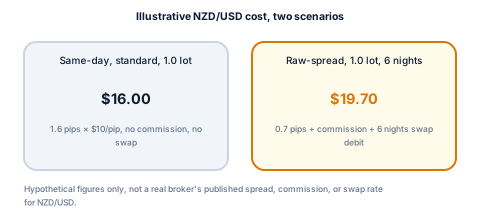
Example 1 — a same-day trade, standard account, 1.0 lot. Illustrative spread: 1.6 pips, at a fixed pip value of $10 for 1.0 lot. Spread cost: 1.6 × $10 = $16.00, no separate commission, no swap since the position closes the same day.
Example 2 — a raw-spread account, same 1.0 lot, held 6 nights. Illustrative spread: 0.7 pips × $10 = $7.00. Illustrative commission: $7.00 per lot round turn. Illustrative swap: −$0.95 per night × 6 nights = −$5.70 (a debit in this example). Total: $7.00 + $7.00 + $5.70 = $19.70.
All figures above are rounded, hypothetical inputs used to demonstrate the formula — not a real broker's spread, commission, or swap rate for NZD/USD, and not a CB-Dogs cashback rate. Notice the same-day standard-account spread cost here ($16.00) is higher than the equivalent AUD/USD example in our AUD/USD cost guide ($11.00) — a direct illustration of the thinner-liquidity, wider-typical-spread pattern discussed above, using these particular illustrative figures.
When NZD/USD's cost tends to move the most
NZD/USD's natural liquidity window centers on the New Zealand and Australian trading day, meaning it can see spreads widen more noticeably during the London and New York sessions' quieter overlap hours, when NZD-specific liquidity providers are largely offline. Scheduled Reserve Bank of New Zealand policy decisions, New Zealand dairy auction results (a closely watched export-revenue indicator), and broader risk-on/risk-off sentiment shifts affecting commodity currencies generally are all commonly associated with sharper NZD/USD moves and wider spreads. The same recurring low-liquidity and session-transition windows from our trading sessions guide apply here too, and are worth checking specifically for a comparatively thin pair like this one.
Does a rebate apply to NZD/USD trades?
Cashback eligibility depends on your broker's own qualifying-instrument list, which commonly includes NZD/USD alongside other USD-quoted majors — check your specific broker's terms via our guide to how forex rebates work. As with any pair, the rebate is calculated on qualifying closed lot volume, not on spread, commission, swap, or the pair's own liquidity characteristics, so it functions as a partial offset against your combined NZD/USD trading cost rather than a reduction of any single component.
Related reading
- AUD/USD trading costs explained — the same three-component breakdown applied to NZD/USD's more heavily traded Antipodean counterpart.
- USD/CAD trading costs explained — another commodity-linked major pair, this one quoted the opposite way around with a CAD-denominated pip value.
- Forex trading sessions: when spreads widen — the general session-liquidity pattern behind why a thinner pair like NZD/USD widens more outside its natural trading hours.
Frequently asked questions
Yes. Because USD is the quote currency in both pairs, a standard lot's pip is worth a fixed $10 in both NZD/USD and EUR/USD. The arithmetic is identical; what differs between the pairs is typical spread and liquidity.
Work out your own numbers
Check your own platform's current NZD/USD contract specification — spread, commission structure, and swap rate and direction — and plug it into the formula above for an accurate total. To see how qualifying volume adds up over time, try the cashback calculator, or register with CB-Dogs before your next trade.
Risk warning: forex and CFD trading carries a high risk of losing money. Cashback does not offset trading losses. Nothing here is investment advice.
Related articles
Cashback on your XM trades — free, paid in USDT
Sign up free