USD/CAD Trading Costs Explained (Spread, Swap, Pip Value)
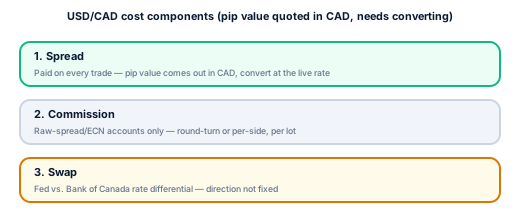
USD/CAD trading cost is built from the same three components as any forex pair — spread, commission on raw-spread accounts, and swap for positions held overnight — but because USD is the base currency and CAD the quote currency, its pip value comes out in Canadian dollars and has to be converted to your account currency, unlike a USD-quoted pair such as EUR/USD.
By CB-Dogs Editorial6 min read
Disclosure: CB-Dogs receives an advertising (referral) fee — sometimes called an IB commission — from brokers for accounts opened or linked through us, and returns part of it to you as cashback, the same model used by cashback and points sites. This does not change your trading costs.
On this page
- The short answer
- Component 1: the spread, and why the pip value needs converting
- Component 2: commission
- Component 3: swap
- Worked example (illustrative numbers)
- When USD/CAD's cost tends to move the most
- Does a rebate apply to USD/CAD trades?
- Related reading
- Frequently asked questions
- Work out your own numbers
Our forex spread cost per trade table lists USD/CAD as one row among several common pairs, and our commission per million guide mentions it as an example of a per-million-notional calculation. Neither walks through the pair on its own. This article does that for USD/CAD specifically: why its pip value comes out in Canadian dollars instead of US dollars, what that means for a USD-based trading account, and a full worked example combining spread, commission, and swap.
Key takeaways
- USD/CAD quotes the US dollar as the base currency and the Canadian dollar as the quote currency, which means its pip value is calculated in CAD, not USD — the opposite arrangement from EUR/USD, GBP/USD, AUD/USD, or NZD/USD, where the pip value comes out fixed in USD.
- For a USD-denominated account, that CAD pip value has to be converted at the current USD/CAD rate to know the actual dollar cost — skipping this step understates or overstates every cost calculation depending on which way the rate has moved.
- The Canadian dollar is widely described as a commodity currency with a documented historical correlation to crude oil prices, since Canada is a major oil exporter — a macroeconomic fact about the currency, not a trading signal.
- Swap on USD/CAD reflects the interest-rate differential between the US Federal Reserve and the Bank of Canada, and like any pair, its direction isn't fixed and changes as rate policy changes.
- A cashback rebate on USD/CAD works the same way as on any other pair: calculated on qualifying closed lot volume, not on spread, swap, or the pip-value conversion step.
The short answer
USD/CAD's trading cost is made up of the same three components as any forex pair — spread, commission (on raw-spread accounts), and swap for positions held overnight — using the standard formula from our lot, pip, and spread cost guide. The one genuinely different step is pip value: because USD is the base currency in this pair (not the quote currency, as in EUR/USD or GBP/USD), a standard lot's pip is worth a fixed amount in Canadian dollars, which then has to be converted to your account's currency at the live USD/CAD rate.
Total USD/CAD cost ≈ (Spread in pips × Pip value, converted to account currency × Lots) + (Commission per lot × Lots) + (Swap rate × Pip value, converted × Lots × Nights held)
Component 1: the spread, and why the pip value needs converting
For most major pairs quoted against the US dollar as the quote currency (EUR/USD, GBP/USD, AUD/USD, NZD/USD), a standard lot's pip is worth a fixed $10 regardless of where the exchange rate sits, because the pip is calculated directly in US dollars. USD/CAD is quoted the other way around — US dollar first, Canadian dollar second — which means a standard lot's pip (0.0001 × 100,000 units = 10 units of the quote currency) is worth 10 Canadian dollars, not 10 US dollars. To know the actual USD cost, that CAD figure has to be divided by the current USD/CAD exchange rate: at an illustrative rate of 1.3600, 10 CAD ÷ 1.36 ≈ $7.35 USD per pip per standard lot. This is the same underlying mechanic covered in general terms in our quote conventions guide — USD/CAD is simply one of the pairs where the base-vs-quote arrangement changes which currency the pip value is denominated in.
Component 2: commission
As with any pair, whether you pay a separate commission depends on account type, not on USD/CAD specifically. A standard account commonly folds the entire cost into a wider spread, while a raw-spread or ECN-style account shows a tighter spread plus a disclosed per-lot commission, following the round-turn-vs-per-side conventions in our commission guide. Neither structure is inherently cheaper for USD/CAD specifically — the comparison depends on the actual spread-and-commission pair your account offers, the same way our raw spread vs. standard accounts guide works through for pairs generally.
Component 3: swap
USD/CAD's swap reflects the interest-rate differential between the US Federal Reserve and the Bank of Canada, using the same mechanism as any pair covered in our swap and overnight fees guide: a rate set by the broker, applied per lot, per night held, in either direction depending on which currency you're effectively long or short and the current rate differential. Like the pip value itself, a USD/CAD swap rate quoted in CAD needs the same conversion step to know its USD cost.
Worked example (illustrative numbers)
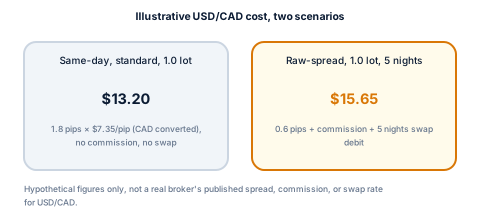
Example 1 — a same-day trade, standard account, 1.0 lot. Illustrative spread: 1.8 pips, at an illustrative pip value of 10 CAD converted at a USDCAD rate of 1.3600, or roughly $7.35 USD per pip. Spread cost: 1.8 × $7.35 ≈ $13.20, no separate commission, no swap since the position closes the same day.
Example 2 — a raw-spread account, same 1.0 lot, held 5 nights. Illustrative spread: 0.6 pips × $7.35 = $4.41. Illustrative commission: $7.00 per lot round turn. Illustrative swap: −$0.85 per night (already converted to USD) × 5 nights = −$4.25 (a debit in this example). Total: $4.41 + $7.00 + $4.25 = $15.65 (rounded).
All figures above are rounded, hypothetical inputs used to demonstrate the formula — not a real broker's spread, commission, or swap rate for USD/CAD, and not a CB-Dogs cashback rate. If your account is denominated in a currency other than USD or CAD, there's an additional conversion step on top of this one, covered in general in our account base currency guide.
When USD/CAD's cost tends to move the most
USD/CAD is most actively traded during the North American session, when US and Canadian market participants overlap, and commonly sees its spread widen and its price move sharply around scheduled US economic data (particularly employment and inflation figures), US Federal Reserve and Bank of Canada policy decisions, and — given the oil correlation discussed above — significant moves in crude oil prices or OPEC-related announcements. The same recurring low-liquidity and session-transition windows from our trading sessions guide apply here too, and are worth checking specifically around the New York close and Asian-session reopen, when North American liquidity thins out. Traders who hold offsetting positions across correlated pairs like USD/CAD and oil-linked instruments should also see our correlation and hedged pair costs guide — a correlated hedge doesn't reduce the transaction cost paid on either leg.
Does a rebate apply to USD/CAD trades?
Cashback eligibility depends on your broker's own qualifying-instrument list, which commonly includes major pairs like USD/CAD alongside other USD-quoted and USD-based majors — check your specific broker's terms via our guide to how forex rebates work. As with any pair, the rebate is calculated on qualifying closed lot volume, not on spread, commission, swap, or which way the pip-value conversion happened to move, so it functions as a partial offset against your combined USD/CAD trading cost rather than a reduction of any single component.
Related reading
- Forex quote conventions and cost implications — the general base-vs-quote-currency mechanic that determines whether a pair's pip value is fixed in USD or needs converting.
- Forex correlation and hedged pair costs — why trading a correlated instrument alongside USD/CAD doesn't reduce the transaction cost on either leg.
- NZD/USD trading costs explained — the same three-component breakdown applied to another commodity-linked major pair, this one quoted with USD as the fixed-pip-value quote currency.
Frequently asked questions
EUR/USD quotes the US dollar as the quote currency, so its pip value comes out fixed in USD. USD/CAD quotes the US dollar as the base currency instead, so a standard lot's pip is worth a fixed amount in Canadian dollars, which then needs converting to USD (or your account currency) at the current exchange rate.
Work out your own numbers
Check your own platform's current USD/CAD contract specification — spread, commission structure, and swap rate and direction — and plug it into the formula above, converting from Canadian dollars at the live exchange rate for an accurate total. To see how qualifying volume adds up over time, try the cashback calculator, or register with CB-Dogs before your next trade.
Risk warning: forex and CFD trading carries a high risk of losing money. Cashback does not offset trading losses. Nothing here is investment advice.
Related articles
Cashback on your XM trades — free, paid in USDT
Sign up free