GBP/JPY Trading Costs Explained (Spread, Swap, Pip Value)
GBP/JPY trading cost is built from the same three components as any forex pair — spread, commission on raw-spread accounts, and swap for positions held overnight — but its pip is the second decimal place (not the fourth), and it's historically one of the wider-spread, more volatile major crosses, which changes the numbers even when the formula is identical.
By CB-Dogs Editorial6 min read
Disclosure: CB-Dogs receives an advertising (referral) fee — sometimes called an IB commission — from brokers for accounts opened or linked through us, and returns part of it to you as cashback, the same model used by cashback and points sites. This does not change your trading costs.
On this page
Our pip value reference guide shows the pip-value formula for USD/JPY as one example among several, and our exotic vs. major pairs guide compares cost patterns across whole categories of pairs. Neither walks through one specific yen cross end to end. This article does that for GBP/JPY specifically: how its two-decimal pip convention changes the arithmetic, why it's commonly quoted with a wider spread than a pair like EUR/USD, and a full worked example combining spread, commission, and swap.
Key takeaways
- GBP/JPY's pip is the second decimal place, not the fourth — the same pip-value formula as any pair applies, but the decimal position changes where the pip actually sits in the quoted price.
- GBP/JPY is a cross pair (neither side is USD), which commonly means a wider typical spread than a USD-quoted major pair, reflecting how the price is built from two underlying legs rather than one direct quote.
- GBP/JPY has historically been associated with sharp, fast moves during risk-off market conditions, which is a volatility characteristic separate from its baseline spread.
- Swap on GBP/JPY reflects the interest-rate differential between GBP and JPY, and can run in either direction depending on current rates — never assume a specific direction without checking your own platform.
- A cashback rebate on GBP/JPY works the same way as on any other pair: calculated on qualifying closed lot volume, not on spread, swap, or which specific cross you traded.
The short answer
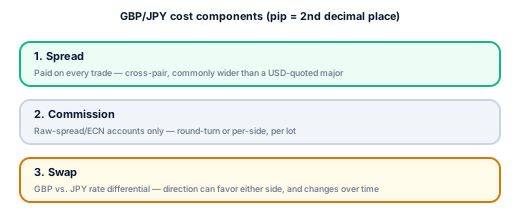
GBP/JPY's trading cost is made up of the same three components as any forex pair — spread, commission (on raw-spread accounts), and swap for positions held overnight — using the standard formula from our lot, pip, and spread cost guide. What differs from a pair like EUR/USD is the pip's decimal position (the second decimal for JPY pairs, not the fourth) and, commonly, a wider typical spread and higher realized volatility.
Total GBP/JPY cost ≈ (Spread in pips × Pip value × Lots) + (Commission per lot × Lots) + (Swap rate × Pip value × Lots × Nights held)
Component 1: the spread, and why the pip sits differently
For most currency pairs, a pip is the fourth decimal place (0.0001). JPY pairs are the standard exception: because one Japanese yen is worth a small fraction of most other currencies, JPY pairs are quoted with two decimal places, and a pip is the second decimal place (0.01) instead. This is covered in general terms in our quote conventions guide — GBP/JPY simply is one of the pairs that convention applies to. Getting this wrong (treating the fourth decimal as the pip, the way you would for EUR/USD) understates the pip size by a factor of 100, which throws off every downstream cost calculation.
GBP/JPY is also a cross pair — neither leg is the US dollar — which is commonly associated with a wider typical spread than a USD-quoted major like EUR/USD or USD/JPY, since the price is effectively built by combining two underlying legs (GBP/USD and USD/JPY) rather than quoted directly against one deep, continuously liquid market.
Component 2: commission
As with any pair, whether you pay a separate commission depends on account type, not on GBP/JPY specifically. A standard account commonly folds the entire cost into a wider spread, while a raw-spread or ECN-style account shows a tighter spread plus a disclosed per-lot commission, following the round-turn-vs-per-side conventions in our commission guide. Neither structure is inherently cheaper for GBP/JPY specifically — the comparison depends on the actual spread-and-commission pair your account offers, the same way our raw spread vs. standard accounts guide works through for pairs generally.
Component 3: swap
GBP/JPY's swap reflects the interest-rate differential between the British pound and the Japanese yen, using the same mechanism as any pair covered in our swap and overnight fees guide: a rate set by the broker, applied per lot, per night held, that can be a credit or a debit on either side of the trade depending on which currency you're effectively long or short and the current rate differential. Historically, yen crosses like GBP/JPY have at times been associated with "carry trade" activity, where the interest-rate gap between the two currencies made holding a specific direction overnight attractive on the swap side alone — but rate differentials change over time, sometimes narrowing or reversing entirely, so a swap direction that held in the past is not a reliable assumption for today.
Worked example (illustrative numbers)
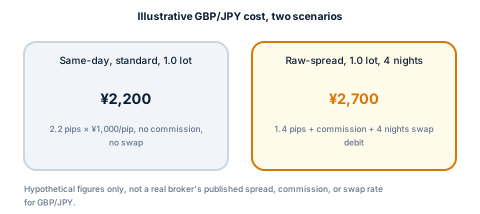
Example 1 — a same-day trade, standard account, 1.0 lot. Illustrative spread: 2.2 pips, at an illustrative pip value of ¥1,000 (roughly $6.70 at an illustrative JPY/USD conversion) for 1.0 lot. Spread cost: 2.2 × ¥1,000 ≈ ¥2,200 (roughly $14.70), no separate commission, no swap since the position closes the same day.
Example 2 — a raw-spread account, same 1.0 lot, held 4 nights. Illustrative spread: 1.4 pips × ¥1,000 = ¥1,400. Illustrative commission: ¥700 per lot round turn. Illustrative swap: −¥150 per night × 4 nights = −¥600 (a debit in this example). Total: ¥1,400 + ¥700 + ¥600 = ¥2,700 (roughly $18.00).
All figures above are rounded, hypothetical inputs used to demonstrate the formula — not a real broker's spread, commission, or swap rate for GBP/JPY, and not a CB-Dogs cashback rate. Your account's base currency changes how the pip value converts, covered in general in our account base currency guide.
When GBP/JPY's cost tends to move the most
GBP/JPY sits at the intersection of two separate sessions' worth of relevant news — UK and eurozone-adjacent data and headlines that move GBP, and Asian-session and Bank of Japan-related developments that move JPY — on top of its general sensitivity to broad risk-on/risk-off sentiment shifts, where JPY often moves as a safe-haven currency and GBP does not. That combination means GBP/JPY can see its spread widen and its price move sharply around events that don't directly concern either currency's own domestic data, simply because it's a common proxy for risk sentiment. The same recurring low-liquidity and session-transition windows from our trading sessions guide apply here too, and are worth checking specifically around the Tokyo-to-London handoff.
Does a rebate apply to GBP/JPY trades?
Cashback eligibility depends on your broker's own qualifying-instrument list, which commonly includes major and widely-traded cross pairs like GBP/JPY alongside USD-quoted majors — check your specific broker's terms via our guide to how forex rebates work. As with any pair, the rebate is calculated on qualifying closed lot volume, not on spread, commission, or swap paid, so it functions as a partial offset against your combined GBP/JPY trading cost rather than a reduction of any single component.
Related reading
- Pip value for EUR/USD, GBP/USD, USD/JPY and gold — the underlying pip-value formula and why JPY pairs use a different decimal convention.
- Exotic pairs vs. major pairs trading costs — where cross pairs typically sit on the spread and liquidity spectrum relative to majors and true exotics.
- AUD/USD trading costs explained — the same three-component breakdown applied to a different major pair with its own swap and session profile.
Frequently asked questions
No. GBP/JPY is quoted to two decimal places, so its pip is the second decimal place (0.01), not the fourth decimal place (0.0001) used by most non-JPY pairs. The pip-value formula is the same; only the decimal position differs.
Work out your own numbers
Check your own platform's current GBP/JPY contract specification — spread, commission structure, and swap rate and direction — and plug it into the formula above for an accurate total. To see how qualifying volume adds up over time, try the cashback calculator, or register with CB-Dogs before your next trade.
Risk warning: forex and CFD trading carries a high risk of losing money. Cashback does not offset trading losses. Nothing here is investment advice.
Related articles
Cashback on your XM trades — free, paid in USDT
Sign up free